Matthew Heans
READING TIME: 5 MINUTES
In Islam, Sijjīn (سِجِّين) is a prison for the damned in the seventh lowest layer of Earth where the souls of infidels are kept. I have to imagine that to the clerics of the Ali Khamenei regime in Iran, there is little difference between this subterranean hell and Tehran at present.
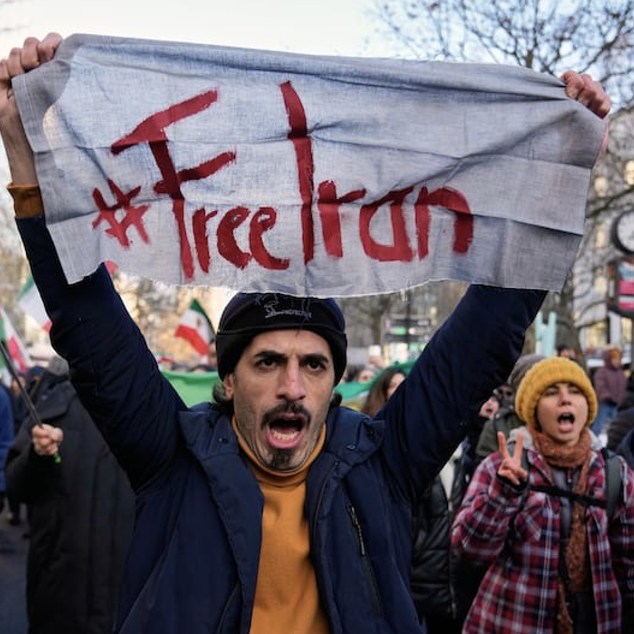
As the rial has been rendered worthless by staggering inflation, millions of Iranians have taken to the streets in protest of the sitting government. All the while, conniving opportunists in Washington and Jerusalem sharpen their knives in wait.
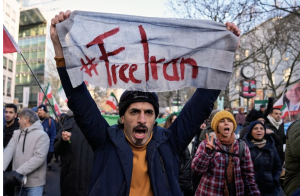
Protestors in Europe and North America engage in solidarity protests with protestors in Iran (Ebrahim Noroozi / Associated Press)
Reza Pahlavi, the Deposed Crown Prince
The worst of the opportunists is Reza Pahlavi, deposed Crown Prince of Iran. Since the protests began on December 28th, his distinctive face has pervaded the legacy media. Touting the importance of regime change for Iran from afar, his self-serving motives are fairly obvious as the heir apparent to the Pahlavi dynasty.
Under the Pahlavi dynasty, a monarchy originally consolidated through a U.S-backed coup of Iran’s democratically elected Prime Minister, Iranians saw considerable democratic backsliding, gross political repression, and extreme wealth inequality.
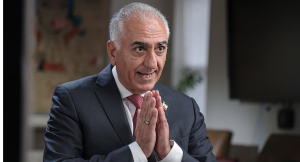
The deposed Crown Prince of Iran, Reza Pahlavi, speaks with the media about the possibility of him returning to Iran as its ruler (Greg Kahn / The Economist)
The last Shah of Iran, and U.S. private investors, pilfered the country’s oil wealth for personal gain during his reign. Now, in some sort of ironic twist, the Shah’s son — the deposed Crown Prince — postures as a stalwart advocate of Iranian economic revitalization and democracy. Where foreigners once grovelled before the Shah, the Shah’s son now grovels before foreign governments in the hope they will help him reclaim his family’s long lost crown.
The Revolution of ’79
Parallels have been drawn between the protests of today and the 1979 Iranian Revolution that first ousted the Pahlavi dynasty from power. In both cases, there is a confluence of economic decline with widespread popular protest, but it is doubtful that this will be enough to topple the government.
In 1979, the revolutionaries had something that those now lack: a united front. Iran’s various institutions — its military, clergy, and ruling political class — all stand in solidarity with the sitting government. While Tehran merchants have brought the bazaar, a former driving engine of Iran’s economy, to a standstill, the impact of this strike is unlikely to be enough to foment dissent among the ruling class.
Crackdowns on Popular Protest
Although the regime had initially publicly sympathized with the protestor’s economic gripes, they quickly pivoted. As of mid-January, they have resorted to violent crackdowns to quell the protests. To help justify this heedless bloodshed, they have accused foreign nationals of working to undermine the country’s sovereignty. 2,500 protestors are estimated to have been killed so far, according to the Human Rights Activists News Agency.
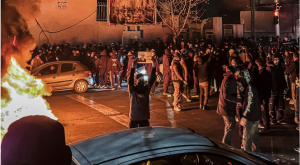
Iranians flock the streets of Tehran in mass protest on January 9, 2026 (Associated Press)
The Islamic Revolutionary Guard Corps (IRGC), the ideological wing of the Iranian military, is suspected to be chiefly responsible for the slaughter of protestors. While they have stayed in the background, not directly involving themselves in disrupting protests, they are believed to be directing operations on the ground. Labeled a terrorist organization by most of the Western world, their rap sheet for human rights violations is a mile long.
The Islamic Revolutionary Guard’s Role
Internet shutdowns have also been employed by the IRGC in cooperation with the government to prevent information on protest crackdowns from being leaked to the foreign media. This tactic has seen some success as only shreds of online footage and images have managed to trickle out of the country since. The few bits of footage that have escaped show mass carnage with body bags riddling the streets of Tehran and machine gunfire clearly audible in the background.
The IRGC is notorious for its outsized influence on the Iranian economy with controlling stakes in several predominant Iranian companies. Through subsidiary companies, the IRGC have profited immensely under U.S. tariff conditions which have simultaneously crippled Iranian buying power.
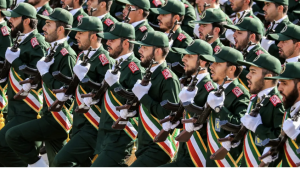
The Islamic Revolutionary Guard Corps staffs 190,000 active personnel and is responsible for preserving the country’s Islamic form of theocratic governance (Associated Press)
Sanctions on Iran have proven lucrative for the IRGC by allowing them to act as the primary medium for tariff circumvention. They thus have much riding on the continued stability of the Ali Khamenei regime and, paradoxically, on the simultaneous impoverishment of the Iranian people.
As the U.S. has made repeated threats to intervene in Iran amid pressure from Israel, human rights activists, and other interest groups, the IRGC has found itself jockeying for position with the U.S. military. The IRGC has stated numerous times that if push comes to shove, it will deploy its vast missile arsenal.
The Threat of U.S. Intervention
Speaker for the Iranian Parliament, Mohammed Bagher Ghalibaf, has declared that if the U.S. intervenes, it will immediately target U.S. and Israeli regional military assets. This rousing speech in the Iranian parliament was followed up by lawmakers shouting “Death to America!”.
Now, in the midst of an unlikely, but potentially existential threat from inside its borders, Iran also faces a much more potent threat from abroad. This week, the United States has ordered an emergency meeting of the U.N. Security Council. Promising to do everything in its power to “stop the slaughter”, the U.S. has made it clear to the U.N. that all options are on the table.
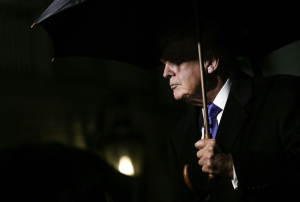
U.S. President Donald Trump speaks with assembled reporters on the state of Iran outside the White House in Washington, D.C, on January 9, 2026 (Brendan Smialowski / Associated Press)
If Iran does not comply with U.S. demands, a revision of the 12-Day War may follow. Much like in 1953 when the U.S. helped to overthrow Iran’s democratically elected Prime Minister, any foreign intervention will likely only have negative consequences for the people of Iran.
Conclusion
One can only hope that the Supreme Leader Ayatollah Ali Khamenei is not so foolhardy as to give the U.S. a convenient casus belli by continuing to flagrantly kill anti-government protestors. If regime change is to come in Iran, it should be on Iranians’ terms; not on the terms of some antiquated former monarch nor that of a foreign imperialist power.
In Islam, much like there is Sijjīn (سِجِّين), the depths of hell, there are also Jinn (جِنّ): spirits with free will and the power to choose between right and wrong. Even as supernatural beings, they are still accountable before God. So too are the clerics of Iran accountable, despite their holier than thou status, for the atrocities they perpetrate against their people.
If the Iranian government does not steer the right course and prevent foreign interventionism while also recognizing their people’s right to demand economic and social reform, their country will suffer for it and the U.S. may yet rock the casbah.