Venezuela has always felt to me like one of those countries where you can see the world’s big tensions play out on a very human scale. It is shaped by its history, its people, its wealth in resources, and by the way powerful nations have behaved towards it for decades. Right now, in early January of 2026, all of that complexity seems to be colliding at once in a way that makes it hard not to think about what we actually mean when we talk about sovereignty, justice, and the limits of power.
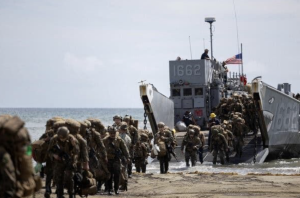
I grew up hearing bits and pieces about Venezuela in the news: about oil, socialism, Hugo Chávez and his fiery speeches against the United States and Israel, and about political polarization. None of it ever really added up until now, when the headlines started carrying something almost unbelievable. The United States carried out a military operation in Venezuela that resulted in the capture of President Nicolás Maduro and his wife, and their transfer to the U.S. to face criminal charges. According to reporting, the operation began in the early hours of January 3rd, 2026, with airstrikes and a small unit action in Caracas, and ended with Maduro and Cilia Flores arraigned in New York on charges including narco terrorism and drug trafficking.
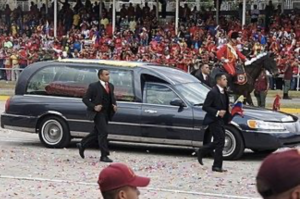
Hearse carrying Hugo Chávez’s remains (Wikipedia/Website)
When I first read that, I sat there for a long minute trying to process it. I think any student of politics knows that American interventions in Latin America are not new, but seeing a head of state seized and flown across borders for trial in another country felt different. It felt like a moment when something basic about international norms was being tested in a very real and uncomfortable way.
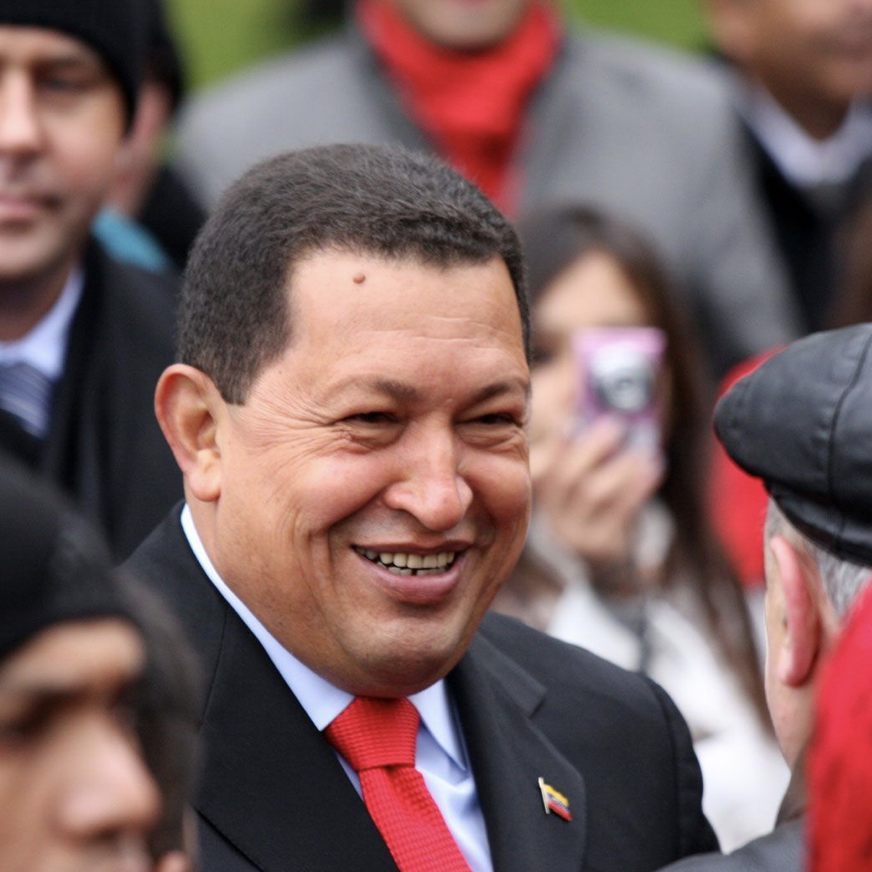
To understand how we got here, you have to go back to Hugo Chávez. He came to power in 1999 and stayed in office until his death in 2013, reshaping Venezuela’s identity at home and abroad. His Bolivarian Revolution challenged U.S. influence, rejected Western dominance, and aligned Venezuela with countries the U.S. viewed as adversaries, including Iran and Russia. He also broke diplomatic ties with Israel in 2009 over military actions in Gaza, framing it as a moral stand against oppression.
When Nicolás Maduro succeeded Chávez, the country was already deeply polarized. The economy deteriorated further, institutions weakened, and millions of Venezuelans left in search of work and safety. Migration became one of the most visible consequences of Venezuela’s crisis and one of the ways its collapse became part of political debates in the United States.
New York Times/Website
For years, the U.S. government sanctioned Venezuela, raised bounties on Maduro, and accused his regime of corruption and drug trafficking. In 2025, tensions escalated with increased military presence in the Caribbean and stronger rhetoric from Washington. Those moves set the stage for the January 2026 operation.
The reaction to that operation was immediate and divided. Some governments and political figures praised what they saw as decisive action against a leader they considered illegitimate. Israel’s prime minister publicly supported the move, calling it a blow against tyranny.
But condemnation was widespread. China’s foreign ministry said it was deeply shocked and called the action a violation of international law. Russia described it as lawless behaviour and demanded Maduro’s release. Iran condemned it as a blatant violation of Venezuelan sovereignty. At the United Nations, Secretary General António Guterres warned that the operation undermined global stability by breaching the principle of non intervention, stressing that Venezuela’s future must be decided by Venezuelans themselves.
That concern was echoed by voices within Venezuela and its diaspora. Paulo Navas, a Venezuelan journalist, called the operation an attack on sovereignty and warned that it set a dangerous precedent for smaller countries everywhere. Venezuelan artist Javier Téllez wrote that even if Maduro was widely seen as illegitimate, foreign military intervention only deepens wounds rather than healing them.
Reactions among Venezuelans abroad were more complicated. Daniel Bastardo Blanco, a Venezuelan expat, said that for many people the removal of Maduro felt like the first real hope in years. Others, like Pedro Velasquez, whose family runs clinics in Venezuela and the U.S., said the sudden violence left them uneasy even if they wanted political change.
In cities across Latin America, Venezuelans gathered to celebrate, waving flags and talking about return and rebuilding. At the same time, members of the diaspora in places like Mexico City condemned the operation as imperialism, showing how divided the community remains.
Inside Venezuela, the situation is tense. Armed militias patrol neighbourhoods, businesses reopen cautiously, and families try to rebuild routines in the middle of uncertainty. At the same time, opposition leader María Corina Machado welcomed the change and called it an opening for new elections and democratic renewal.
What stands out to me is how much history shapes how people interpret this moment. Chávez’s anti-Western rhetoric was not just theatrical. It drew on a long Latin American history of resisting external domination, from colonial rule to Cold War interventions. That history still informs how many people in the region see U.S. power today and why they frame this operation as a violation of international norms rather than a rescue mission.
This also connects directly to U.S. domestic politics. Venezuelan migrants in the U.S. have faced shifting immigration policies, deportations, and uncertainty over protections like Temporary Protected Status. Migration becomes both a result of instability abroad and a political issue at home, tying foreign intervention and domestic enforcement together in ways that are often ignored.
From a historical perspective, Venezuela fits into a longer pattern of U.S. involvement in Latin America, from Panama in 1989 to earlier interventions and pressure campaigns. Each time, those actions reshaped not only governments but how entire societies viewed the United States and its role in the region.
So I do not see this as a story about good and evil or heroes and villains. I see a web of history, power, ideology, and human cost. I see people who want change, people who fear chaos, governments that defend principles, and governments that defend interests.
I also think about Venezuela’s oil. Its reserves made it geopolitically important for decades, and even as production has declined, control over that wealth still shapes global attention and alliances.
As someone who studies politics, the hardest part is that there are no clean answers. It is painful to see suffering continue inside Venezuela. It is worrying to see international norms stretched or broken. It is frustrating to watch these events reduced to slogans.
Maybe that is why this moment feels bigger than one country’s crisis. It feels like a test of whether sovereignty, self determination, peace, and stability are real constraints on power or just words we use when they are convenient. That question matters not only to Venezuelans but to everyone trying to understand what kind of global order we are actually living in.


![Policemen stand guard in front of the Bangladesh Election Commission office ahead of the general election schedule announcement in Dhaka, Bangladesh, December 11, 2025 [Mohammad Ponir Hossain/Reuters]](https://thebaron.ca/wp-content/uploads/bb-plugin/cache/Screenshot-2026-01-23-at-9.48.54-AM-square-9f2b98d2eff6d31d5a83828c4d5ff7ce-.png "Screenshot 2026-01-23 at 9.48.54 AM")