Over the past few weeks, Bangladesh has been moving through a period that feels both politically heavy and socially fragile at the same time. The country is preparing for a general election scheduled for February 12, 2026, and it will be the first national vote since the political upheaval of 2024 that forced long time Prime Minister Sheikh Hasina from power. That shift did not simply replace one government with another. It disrupted political routines, shifted alliances, and left many people uncertain about what comes next.
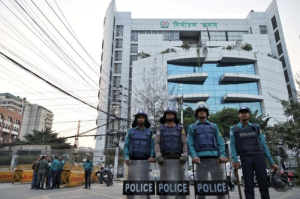
Policemen stand guard in front of the Bangladesh Election Commission office ahead of the general election schedule announcement in Dhaka, Bangladesh, December 11, 2025 (Mohammad Ponir Hossain/Reuters)
Bangladesh is currently governed by an interim administration led by Muhammad Yunus, a Nobel Peace Prize laureate who stepped into politics during a moment of instability rather than celebration. His government is responsible for managing daily affairs while also overseeing the election and guiding a reform process that includes discussions about institutional and constitutional change. This places the temporary government in an unusual position, acting as both caretaker and organizer at the same time, which creates mixed feelings among citizens about legitimacy and authority.
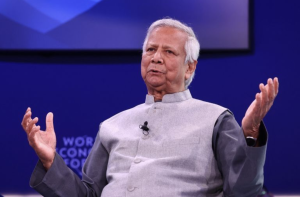
Muhammad Yunus, Chief Adviser of the interim government of Bangladesh, attends the 55th annual World Economic Forum (WEF) meeting in Davos, Switzerland, on January 23, 2025 (Yves Herman/Reuters)
The political landscape looks very different from even a few years ago. Sheikh Hasina’s Awami League dominated politics for over a decade, and her departure marked the end of an era. Her party’s participation in the upcoming election remains uncertain, and her absence has left a vacuum that no single group has clearly filled. The Bangladesh Nationalist Party remains a major force, but it too is in transition. Its longtime leader and the country’s first female prime minister, Khaleda Zia, died on December 30, 2025 after a prolonged illness. Her funeral in Dhaka drew massive crowds and foreign dignitaries, reflecting her lasting political and emotional influence.
New political movements are also trying to establish themselves. The National Citizen Party emerged from youth-led protests in 2024 and initially attracted support from people frustrated with traditional politics. However, internal disagreements have weakened the party, particularly after its decision to cooperate with Jamaat e Islami, an Islamist group with a controversial past. Several senior figures resigned, revealing tensions between political pragmatism and the ideals that originally motivated the movement.
Alongside political change, social tensions have become more visible. Several recent violent incidents involving members of the Hindu minority have drawn attention and concern. One involved a Hindu businessman in Shariatpur who was attacked and set on fire. Another involved a Hindu garment worker killed during mob violence. These cases spread quickly through media and social platforms, becoming symbols of broader fears among minority communities.
International reactions followed. The United States urged Bangladeshi authorities to protect minorities and hold perpetrators accountable. The interim government condemned the violence and promised investigations, while also cautioning against interpreting every incident as religiously motivated, noting that some cases may involve criminal disputes rather than communal targeting. This difference in framing highlights the complexity of interpreting violence during politically tense periods.
Human rights organizations have provided important context. Human Rights Watch reported that after the unrest of 2024 there were attacks on political supporters and religious minorities, including Hindus and Ahmadi Muslims, while also documenting cases where Muslim neighbours protected minority communities. These mixed responses reflect the reality that social dynamics are not uniform and cannot be reduced to a single narrative of division.
Historical memory also shapes current anxieties. Minority Rights Group International has documented long-standing concerns among Hindus related to land dispossession and marginalization, often tracing them back to laws such as the Enemy Property Ordinance and the Vested Property Act, which disproportionately affected Hindus. Even though these laws have been repealed or reformed, their legacy continues to influence how secure people feel during times of instability.
The information environment has become another area of concern. Journalists and civil society groups have reported pressure and attacks on media institutions. Fact-checking organizations have warned about misleading videos and false claims circulating online, particularly around communal violence. In a tense political environment, misinformation can spread faster than corrections and deepen fear and mistrust.
Bangladesh’s transition is closely watched internationally. Indian and Pakistani officials attended Khaleda Zia’s funeral, drawing attention because of broader regional tensions. Analysts often note that Bangladesh’s stability matters because of its population size, economic role, migration patterns, and strategic location in South Asia.
Economic uncertainty adds another layer. Bangladesh’s garment industry employs millions and depends on stable trade relations. Political instability and security concerns can disrupt supply chains and deter investment, affecting workers far from political centres.
Authorities say they are preparing security measures for the election and aim to ensure public order, protect citizens of all religions, and conduct a credible vote. Political parties are campaigning and forming alliances, while civil society groups call for transparency and restraint. International observers are watching whether conditions for a free and fair election exist.
For many people, however, the central concern is not which party wins but whether daily life remains safe and predictable. Families worry about violence. Minority communities worry about protection. Young people who protested for change worry about whether their voices will be absorbed into old political patterns.
In cities and towns, daily routines continue alongside political uncertainty. Shops open, buses fill, students attend classes, and families gather for meals, even as headlines warn of instability. This coexistence of normal life and political tension defines the moment.
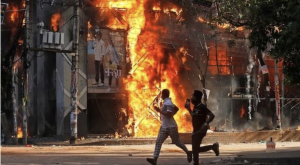
Bangladesh’s Prime Minister Shaikh Hasina has resigned and fled the country following weeks of violent anti-government protests (CBC News).
What makes this election feel different is not only the political transition, but the emotional fatigue surrounding it. Many people are tired of conflict, corruption, and instability, and want institutions that function and laws that matter.
The coming weeks will test whether political competition can remain peaceful, whether security forces act impartially, whether media reports responsibly, and whether communities resist fear and rumour. The answers will shape whether this period becomes a foundation for stability or another chapter of uncertainty.
At its core, this election is about trust: trust in institutions, trust in neighbours, and trust that the future will be more predictable than the past. Whether that trust grows or erodes will shape Bangladesh’s political and social life long after the ballots are counted.


![Policemen stand guard in front of the Bangladesh Election Commission office ahead of the general election schedule announcement in Dhaka, Bangladesh, December 11, 2025 [Mohammad Ponir Hossain/Reuters]](https://thebaron.ca/wp-content/uploads/bb-plugin/cache/Screenshot-2026-01-23-at-9.48.54-AM-square-9f2b98d2eff6d31d5a83828c4d5ff7ce-.png "Screenshot 2026-01-23 at 9.48.54 AM")