Himanshu Sharma
READING TIME: 4 MINUTES
Gaining post-secondary education is ever important in today’s fast developing economy, but it comes with a great cost to bear in mind. Students who are aiming to get these diplomas, associate degrees, or bachelor degrees are facing hurdles in the shape of financial instability. Financial problems are creating barriers against them displaying their full merit and attaining the education they deserve to receive. In Canada, one major institution working to solve this issue is the Canadian Alliance of Student Associations, also known as the Alliance canadienne des associations étudiantes or AC, applicable to the French-speaking Canadian provinces. CASA was established in 1995 and represents a non-partisan, non-profit advocacy association involving student bodies from all over Canada.
The main idea of the organization is to advocate for accessible, affordable, innovative, and high-quality post-secondary education. The activities include the development and creation of policy, research, government relations, awareness campaigns, and partnerships with other stakeholders to ensure that students are truly represented in Ottawa, where the federal government makes important decisions for all the students in Canada. This is corroborated by their stated vision: “Canada will achieve an accessible, affordable and high-quality post-secondary education system whose students enjoy an excellent quality of life.” Affordability is not merely a side issue for CASA; it is one of its foundational principles.

CASA/Website
The issues that CASA raises, which are heavily tied to affordability, reveal a larger crisis that is faced not just by Canadian students, but by students all around the globe. There is no doubt that the cost of post-secondary education is increasing every year. Although post-secondary education is, in many cases, a strong determinant of one’s long-term income, the tuition to get there is simply no longer affordable for many. It is also wrong to assume that it is merely tuition contributing to the affordability crisis; students may be challenged by housing, food security, and other costs that may equal, if not surpass, their educational goals. It has been observed that the median rates for rent have also gone up and can cost up to $27,000 for an average student per year. These challenges leave students in a very hard position: one in every three students forego the purchase of textbooks to save money, one in four miss deadlines for their tuition payments, and many other students face food insecurity or housing crises.
This tells us that the numbers don’t lie. Students facing affordability crises is not just a problem in theory, but a very real problem that many of them are currently facing. This very real problem needs addressing, and this is where the CASA steps in. In its initiatives, CASA has held several meetings with federal members of Parliament during November’s Advocacy week, where they presented proposals on what changes and revamps are required for the existing policies. They have also represented student consensus in many national level meetings. These proposals include the Enhancement and Expansion of Canada Student Grant initiatives, the Enhancement of Maximum Loan Limits, and the Creation of the Canada Student Housing Strategy, aimed at constructing non-profit student housing facilities.
The public opinion data regarding concerns faced by students also highlights the importance of the work that CASA is undertaking. These surveys suggest that while students understand how post-secondary education could help them in their personal and professional lives, they are hesitant because they fear the negative implications of the high costs and student debt they have to consider. This halts enrolment numbers and hinders students’ ability to capitalize on their strengths and qualifications.
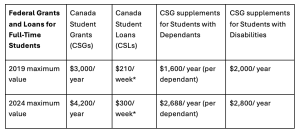
Table of the rates for CSG, CSL, CSG with Dependants, and CSG for students with Disabilities.
Conclusively, as a result of various requests and understanding the perspective of CASA, the government has launched various initiatives to support students and to ease their plight. These benefits include, but are not limited to, increasing the non-repayable grants and the interest free Canada Student Loans. A lot of these policies are a direct result of the pressure from bodies like CASA that amplify student voices. However, CASA and its supporting organizations still believe that there is a long way to go, and that there exists a great need for more initiatives to thoroughly address the issues faced by students.
Ultimately, however, the crisis of affordability presents a deeper challenge to the principles of equity and access that post-secondary education seeks to uphold. The work of organizations such as CASA, therefore, remains very important in addressing the gap that exists between the world of student realities, on the one hand, and the world of decision-making, on the other. They serve as a reminder that education must be a route to empowerment, not to debt. The continued efforts of CASA, therefore, involve making post-secondary education both accessible and affordable for Canadians.
SHARE