Jonathan Bruce
READING TIME: 12 MINUTES
Comedy is a difficult genre in that trying to be funny takes hard work, practice, and understanding what humour can be. Yet it also has the issues of changing times, political correctness, and whether or not something is truly hilarious. Several comedians have had to rein in racy humour and/or clean up their act. Richard Pryor, for example, uttered racial epithets in his stand-up comedy routines, but eventually stopped using them as time passed. Other comedians experienced the harsh reality of changing times as what was considered acceptable became no longer appropriate.
But what happens when someone is stuck in their ways and refuses to change? Or rather, what happens if said person can’t change? And how do we as a society deal with such individuals?
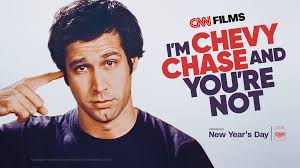
I’m Chevy Chase And You’re Not attempts to answer those questions. The movie is the latest documentary from filmmaker Maria Zenovich (Roman Polanski: Wanted and Desired). It examines the subject of Chevy Chase. At 82 years old, the veteran comedian-actor has been an entertainer for over fifty years. Since his debut on Saturday Night Live, Chase branched out from television to feature films over a four decade period. Despite being around for a long time, the comedian hasn’t had any substantial work in recent years — and for good reason.
CNN Films
From the outset, Chase comes across as evasive and not very sympathetic. Even his first interview with the director is tense from the start. When Zenovich admits to having difficulty figuring him out, the comedian counters her by saying, “It’s not going to be easy for you”. After she asks why, Chase says: “You’re not bright enough. How’s that?” Zenovich reacts in disbelief, to which her subject says “My answer is I’m complex, and I’m deep, and I can be hurt easily, and I react spontaneously to people who want to figure me out, as it were.” However, there are moments in which the classic Chase emerges out of his protective shell for a brief laugh or two. The opening features the comedian eating breakfast as the camera crew starts to prep for filming, to which he exclaims, through a mouthful of food, “What the f*** is this?” He then stops this mock rant to utter a raspy, guttural laugh that is all too familiar to comedy fans. Another compelling scene is a live screening of National Lampoon’s Christmas Vacation, in which he shows his witty sense of humour is still intact. At times, it almost feels like the viewer is watching an octogenarian version of Chase’s onscreen counterpart Clark Griswold.
Yet the problem with Chase is that he doesn’t seem to realize how he comes across. Either it is a lack of awareness or a blatant “I don’t care” stance. There are a number of uncomfortable moments throughout Chase’s career in which he has antagonized and bullied people, such as a legendary tense interview with the Dangerfields in which he insulted a journalist. And therein lies the problem which Zenovich’s documentary attempts to explore when dealing with this talented yet complicated individual. How do you explain or understand a person who can’t/won’t change? Furthermore, does cancel culture even work these days?
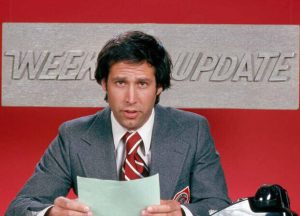
Growing up in the 1940s and 1950s, Cornelius “Chevy” Crane Chase channeled his restlessness and energy into performing during high school and university. After trying his hand at writing, he began performing in underground comedy troupes. Having written for the Smothers Brothers and The National Lampoon Radio Hour, Chase was given the opportunity to become a writer on NBC’s Saturday Night Live in 1975. Initially, he was meant to only write for the show, but he demanded the chance to become a cast member. Thus, Chase was added to the “Not Ready For Prime-Time Players” ensemble, which included John Belushi, Gilda Radner, Dan Aykroyd, Jane Curtin, Garrett Morris, and Laraine Newman. He quickly proved to be a popular on the series with his impersonations of Gerald Ford and Leonard Nimoy’s Spock character from Star Trek. One major segment of Saturday Night Live was the “Weekend Update”, a mock news program in which Chase hosted alongside Curtin. He also coined the catch phrase “I’m Chevy Chase…. And you’re not”, which perfectly sums up his attitude and general demeanour. Martin Short is one of those interviewed in the documentary. His take on Chase’s talent is as follows: “He has this glint in his eye that makes you feel that there’s a bit brain in there, and it’s ready to say something really funny or sarcastic or edgy.” Goldie Hawn recalls her onscreen collaborations with Chase, acknowledging he had few boundaries but could be hilarious. Saturday Night Live producer Lorne Michaels describes the phenomenon that the comedian became: “If you were at Yankee Stadium with Chevy, everybody would know he was there.”
When reviewing the actor’s time on the show, there are two things that particularly stand out in the documentary. First, Chase tended to rely too much on his physical shtick of prat-falling and/or tumbling down stairs. While it brings silent film stars like Buster Keaton and Charlie Chaplin to mind, the recurring gag of Chase falling down comes off as being somewhat formulaic and repetitive. Another distinguishing trait was his cocky smugness, particularly when performing in sketches and even in interviews. This arrogance worked for the “Weekend Update”, in which Chase’s smug persona fit the WASP-type upper class newsmen he was spoofing. Ultimately, Chase’s range as an actor is shown to be somewhat limited, because the majority of his characters are self-centred, abrasive, and arrogant. Whereas Belushi, Aykroyd and Radner played a variety of off-beat, quirky roles, Chase tended to fall back (figuratively and literally) on his typical tropes and mannerisms.
Chase also has an ever-present capacity to shock and outrage people with his controversial behaviour. One infamous SNL sketch involves Chase interviewing guest host Richard Pryor for a janitorial position. The interview goes from standard questions to a word-association game that culminates in Chase using the “N-word” directed at Pryor. While the sketch ends with Pryor getting the last word in, the casual use of racial slurs is both jarring and troubling to watch. Years later, Chase attempts to justify his choice of language by claiming the friendship with the late Pryor made it acceptable. Granted, any instance of a white person using the “N-word” is not appropriate in any context — whether it be an attempt at humour or in seriousness.
NBC
As the first season of Saturday Night Live came to a close, it became apparent that Chase already had one foot out the door. His popularity led to film studios courting him with movie offers, which would mean leaving the show. Television critics also declared him the heir apparent to legendary talk-show host Johnny Carson, and some even speculated that he’d be the next one to host The Tonight Show. Despite being a regular on SNL, he never actually signed a five-year contract and chose to leave during the second season. Despite attempts by Michaels to get Chase to stay, in the documentary he attributes his decision to leave SNL as due to his ex-wife hating New York and wanting to live in Los Angeles. While this comes off as a classic case of “never my fault”, the attempt to blame his former wife comes off as misogynistic and mean-spirited. Furthermore, it also shows a man who’s troubled by his past decisions and refuses to accept responsibility for his own actions.
Upon leaving SNL, Chase landed his first starring feature role with Foul Play, a romantic comedy with Goldie Hawn. Although the film was financially successful, it received mixed reviews from critics and audiences. Nevertheless, Chase persisted in pursuing further movie roles. His starring turn in Caddyshack proved to be a box office hit. For the rest of the decade, he starred in a series of lucrative films, such as Fletch, the National Lampoon’s Vacation franchise, Spies Like Us, and The Three Amigos. But the documentary goes deeper and reveals Chase didn’t really know what he wanted to achieve as an actor. Mike Ovitz, Chase’s long-suffering former manager, admits that his client had no agenda or long-term trajectory for his Hollywood career. “I never got the sense that Chevy was as serious about his career as his career was serious,” he says. “We had clients so focused on building what role went next, and he didn’t think that way.” While it’s true that Chase scored hits with Caddyshack, the National Lampoon’s Vacation franchise, and The Three Amigos, it must be remembered that those movies were largely ensemble features and not solely dependent on his talent. Fletch was arguably a Chase vehicle, but its success could very well be the exception instead of the rule.
During production on Under the Rainbow, Chase met and became smitten with a young production coordinator named Jayni Luke, but it was not exactly love at first sight. Jayni recalls Chase inviting her to the premiere of his latest film, to which she responded “Not if I’m third choice”. The two got married not long afterwards, eventually having three daughters: Sydney, Caley, and Emily. Chase himself can’t seem to believe how he ended up with such a woman; in a rare moment of vulnerability, he states, “She’s beautiful and smart as a whip. I have nothing much to say about her that isn’t good”. The comedian acknowledges how fortunate he is, yet he claims not many people have what he has.
Throughout the 1980s and 1990s, Chase would return to occasionally host episodes of Saturday Night Live. As his manager admits, “When Chevy came back to host, I don’t think anyone was prepared of the Chevy that shows up. Almost like it was beneath him to do so.” Even his opening monologue speech had undertones of disdain for the subsequent cast members. Chase’s 1985 appearance proved to be quite controversial, because he mocked and belittled openly gay cast member Terry Sweeney for his sexuality. According to the SNL book Live From New York, Chase made things even more uncomfortable by suggesting an off-colour sketch in which Sweeney would play an AIDs patient who gets weighed each week before he dies. Michaels demanded Chase apologize, to which he reluctantly did so. Years later, Michaels admits Chase’s sensibilities rubbed people the wrong way: “I think Chevy was just being Chevy. He would say things that were funny but he would assume that you were comedy people and he could speak that way.” Although Sweeney declined to appear in the documentary, he is discussed in depth when Chase ignorantly makes the assumption that he’s dead: “I don’t think he’s alive anymore. I hope he isn’t, cause I don’t want you talking to him about this.” When told by Zenovich that Sweeney is alive, he reacts with mock surprise, saying “Oh he’s alive, the gay guy!” Despite being confronted with his behaviour, Chase reacts with disbelief that he hurt Sweeney’s feelings, but he denies “None of that’s true. I would remember that, that I was angry and had to apologize to him? Good God, Chevy, what’s wrong with you? That’s just not true.” He even has the audacity to accuse Sweeney of lying, claiming “That isn’t me. That’s not how I am. And if I am that way, my life has changed because I have to live with that now for the rest of my f***ing life because you guys got a book out and read it to me.” Evidently, self-awareness is not one of Chase’s qualities.
One telling sign of Chase’s destructive behaviour is repeated drug and alcohol abuse. Due to this subject matter, the documentary begins with a disclaimer warning people about the drug references and urging them to “please watch responsibly”. Although Chase engaged in substance abuse, he appeared to make fun of his own addiction, such as snorting a long line of cocaine in his movie Modern Problems while imitating Donald Duck. Chase’s brother Ned recalls going out to dinner with Chase and seeing a lazy Susan full of cocaine stacked like a pyramid. Film producer Alan Greisman recounts a story about Chase having cocaine shipped to a Hawaiian hotel in a shaving cream can. For his part, Chase admits this incident is true, chuckling “Every so often, we’d have some cocaine flown in from the mainland. Mail’s here!” A difficult anecdote has Jayni being informed of Chase’s drug addiction, which led to an intervention and the actor being sent off to rehab. Following his firing from the Community sitcom, Chase turned to drinking as a means of coping with the stressful situation.

NBC
Another telling sign of the documentary is the limited number of defenders willing to speak up on Chase’s behalf. In addition to the previously-mentioned Martin Short and Goldie Hawn, actor Ryan Reynolds, actress Beverly D’Angelo, filmmaker Kevin Smith, and Chase’s current manager voice their thoughts on the comedian. Reynolds is effusing in his praise, saying “As a kid, I studied him. He would throw the gold away and push the silver, like he would say something and that’s funny. Then under the breath, quickly throw away something. That’s the A+ joke.” Some of his SNL costars do appear and voice their thoughts, such as Aykroyd and Morris. They acknowledge that Chase can be abrasive and difficult, yet praise his talent and genuine friendship. Even Lorne Michaels offers his opinions about Chase’s talent, but it is clear that he doesn’t relish talking about the comedian. Yet the fact that Curtin, Newman, and Murray refused to participate also speaks volumes. None of the cast of NBC’s Community feature in the documentary to discuss their costar; it is apparent they are long since over Chase. However, Jayni and their three daughters do appear to share memories of their family life. Granted, these perceptions may very well be biased, as they haven’t witnessed more of his abrasive outbursts or controversial behaviour.
By the end of the 1980s, Chase’s tenure as a movie star had begun to wane. A string of box office failures (Funny Farm, Fletch Lives, Caddyshack II, Deal of the Century, Nothing But Trouble) in the early 1990s showed audiences were growing tired of him and were no longer interested in pratfalls or mugging for the camera. Memoirs of an Invisible Man marked the turning point where Chase’s difficult behaviour and temperament began to affect his standing in Hollywood. Production on the movie was a troubled, difficult shoot due to Chase’s attitude, and director John Carpenter contemplated leaving the film business. Footage of filming depicts the comedian being disagreeable on set and getting on Carpenter’s nerves. After it flopped, Chase found himself no longer in demand as a leading man.
Determined to make a comeback, Chase found himself landing a deal with 20th Century Fox to host his own talk show. Debuting in fall 1993, The Chevy Chase Show opened to receive low ratings and mixed to poor reviews. Now in middle-age, the comedian seemed uncertain and sounded awkward in telling jokes while working an audience. The show largely relied on Chase’s SNL fame, and one segment practically rips off the latter’s “Weekend Update” segment. His interviews with celebrity guests proved to be uncomfortable and often tense, such as an infamous conversation with actor Robert De Niro. Ultimately, the show was cancelled after six weeks and twenty-nine episodes. What the documentary doesn’t reveal, however, is that Chase wasn’t even the network’s first choice to host the show. Fox had originally offered the gig to singer-songwriter Dolly Parton, who turned it down. Furthermore, the challenge of competing with CBS’s Tonight Show and NBC already proved to be difficult. Nevertheless, The Chevy Chase Show’s cancellation seemed to mark the end of his television career. Further rubbing salt in the wound was the network officially cancelling the show on his birthday. To add insult to injury, Late Night With Conan O’Brien premiered to critical acclaim and stellar ratings a few weeks later.
For most of the 1990s and 2000s, Chase spent his time in upstate New York raising his three daughters. Occasionally, he would appear in feature films in supporting roles or cameos. As he aged, Chase’s bankability as an actor declined, and the movie offers eventually dried up. In 2009, he received a rare opportunity for a comeback in television with the show Community. The series focused on a group of adults attending a community college, and Chase played the crass, politically-incorrect millionaire Pierce Hawthorne. Despite being a featured player, he received positive reviews and gained a new generation of fans who were unfamiliar with his SNL and 1980s output. After the first three seasons, tensions began to surface when Chase butted heads with showrunner Dan Harmon. Episode director Jay Chandrasekhar recounts Chase being disagreeable with him on set and holding up production. By the fourth season, a disagreement over the show’s humour resulted in a scene where Chase does a Señor Wences blackface puppet. It also led to Chase using racial epithets directed at Community cast members Donald Glover and Yvette Nichole Brown. In response, Harmon leaked Chase’s voice mail to the media. When Chase’s racial slurs went viral, he proceeded to throw a tantrum on the set and lash out at the whole crew. After heated controversy on the set, he ended up leaving the show by mutual agreement with NBC, and the character of Pierce was killed offscreen in the fifth season. Harmon was later dismissed from his role as showrunner.
Zenovich attempts to explore the most puzzling question: why exactly is Chase the way he is? The documentary includes reminiscences from his brother Ned Junior and former school friends talking about his difficult childhood. As in most troubled family backgrounds, divorce played a major role in shaping who he came to be. His father, Ned Chase Senior, is spoken of in fond terms, and Chase cites him as being a humorous person. Ultimately, it is his mother Cathalene who frequently factors as a tough, overbearing disciplinarian and emotionally distant parent in these stories. His stepfather John Cederquist was a psychoanalyst with an overbearing demeanour and no sense of humour. One particularly difficult story involves Cathalene waking Chase up and slapping him repeatedly. Another incident has Chase being locked in the basement for receiving poor grades in school. Cathalene’s abusive behaviour is speculated to be schizophrenia or bipolar disorder, but this is never explored in depth or elaborated on. While it doesn’t excuse Chase’s toxic behaviour, the treatment he endured from his mother and stepfather might partially explain his abrasive personality.
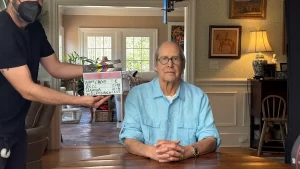
Perhaps the most somber moments depict Chase at home and playing piano. Jayni describes Chase as being a devoted husband and father. His near-death experience with heart failure in 2018 is discussed in unsettling detail. Chase’s daughters recall the eight day coma in which their father almost didn’t recover. The result has made the comedian more frail, older than his 82 years. The heart attack has reportedly caused Chase to lose most of his memory. When being read transcripts of the Terry Sweeney incident, he bursts out laughing and describes said behaviour as “the worst”. As previously mentioned, he attempts to discredit Sweeney’s recollection, despite having no memory of what took place. It really begs the question as to whether or not Chase has changed from being the same person he was thirty to fifty years ago.
CNN Films
Overall, I’m Chevy Chase And You’re Not is a fascinating look at how comedy has changed overtime. Zenovich continues to excel at examining flawed, complex individuals and what makes them function the way they do. The documentary also poses the question of how effective “cancel culture” is and whether or not to “cancel” someone for bad behaviour. As in real life, there are no easy answers in how to deal with such a person. Three and a half out of four stars, and this writer thanks God he is not like Chevy Chase.
I’m Chevy Chase And You’re Not is now streaming on the CNN app.
SHARE



Good Night and Good Luck Delivers an Impressive, Intimate Look at The Media