Jonathan Bruce
READING TIME: 5 MINUTES
Stage adaptations of popular films tend to be hit or miss. A number of these productions are a carbon copy of the source material and offer nothing new. Some adaptations, however, like Andrew Lloyd-Webber’s take on School of Rock (2017) or 2019’s Some Like It Hot do well with both critics and audiences. Others, like 2021’s Mrs. Doubtfire (based on the hit comedy starring Robin Williams) and 2022’s New York, New York (based on the 1977 film by Martin Scorsese) prove to be commercially and critically disappointing due to emulating the source material without making things interesting or to current audiences simply not being familiar with the material.
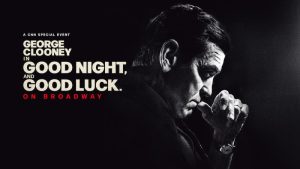
Enter George Clooney’s recent Broadway debut, Good Night and Good Luck. It was based on a 2005 drama film that Clooney directed, produced, wrote, and acted in, and the movie proved to be an Oscar-nominated success. Adapted for stage by Clooney and his producing partner Grant Heslov, the play ran at the Winter Garden Theatre in New York City last year from March to June and earned five Tony nominations. Directed by David Cromer, this stage production is notable for having its penultimate performance aired live on CNN, HBO Max, the CNN app, and CNN.com. It marked the first time in history that a Broadway production was aired live on television. Clooney has asserted the play still has more life left in it, which includes a national tour across the United States and a planned transfer to London’s West End theatre district. Most recently, the filmed performance of Good Night and Good Luck made its streaming debut on Netflix earlier this year.
Magnolia Pictures and Netflix
Set in 1953, Good Night and Good Luck concerns the efforts of Edward R. Murrow and his See It Now news team at CBS. The latest focus of their reporting is the ongoing communist witch hunts by Senator Joseph McCarthy and the House of Un-American Activities. Such witch hunts include a military man being accused of having communist sympathies and Murrow is convinced that they have to report the news no matter how uncomfortable and difficult it might be for CBS. His producer Fred Friendly (Glenn Fleshler) feels worried about pressure from the network. Ultimately, Murrow’s boss Bill Paley (Paul Gross) tries to get him to tone down the criticism of McCarthy because he doesn’t want to lose any of their affiliates or sponsors. Paley is also concerned with Murrow’s frequent habit of taking on controversies via his news reporting. After one Colonel Anderson (Mac Brandt) arrives to question Paley, the tensions between employer and employee become even more apparent. Now, it appears that McCarthy is turning his attention on Murrow and the news team. Meanwhile, there are other tensions within the newsroom. Two colleagues Joe (Carter Hudson) and Shirley Wershba (Ilana Glazer) have a marriage that is being kept secret from their workplace, because fraternization in the workplace is forbidden. When coworkers are being asked about their loyalty to America, Joe and Shirley become even more uncomfortable. Both of them feel conflicted about whether to break things off or to leave CBS should their marriage come to light.
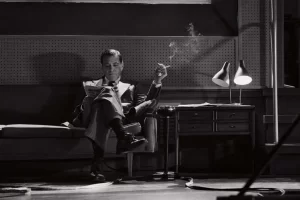
Clooney is in fine form as Murrow. Having a vast knowledge of history and journalism (from his father, journalist Nick Clooney), the Hollywood veteran taps into the 1950s with relative ease. Perhaps most noticeably, Clooney has dyed his grey hair black, so as to closely resemble the late Murrow. While he taps into his suave, confident Hollywood persona at times, it must be noted that Murrow himself was a larger-than-life figure who people paid close attention to whenever he spoke.
Magnolia Pictures and Netflix
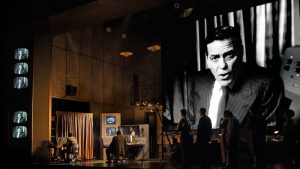
The rest of the cast does well in their roles. Glen Fleshler depicts Fred Friendly as Murrow’s confidante and worried voice of reason. Clark Gregg (Agents of S.H.I.E.L.D) brings a sense of world-weariness to Don Hollenbeck. Paul Gross comes across as the play’s closest thing to an antagonist with his tough, aggressive take on William Paley. Carter Hudson and Ilana Glazer bring a sense of commitment and anxiety to the story by showcasing how professional tensions can affect one’s personal life. Although McCarthy isn’t a stage character in the play, he is included throughout the production via archive footage, which adds to the vintage feel of the story.
As is par for the course, there are a few noticeable changes made in adapting the film to the stage. For instance, the character of Murrow is given the most focus in the play, whereas he was an ensemble member in the movie. While Clooney plays Murrow here, he previously portrayed Friendly in the film version. In recent interviews, the actor has admitted to not having had the gravitas in his early 40s to play Murrow. Another addition is the choice of incorporating jazz-op songs into the plot, sung by actress Georgia Heers. Although some might call this a weak attempt at transitioning scenes, the choice of music adds to the 1950s setting.
When linking the (then) past to the present day, Clooney’s final monologue is delivered amid a slideshow projection of various news events from the 1950s up until the 2020s. Said projections include the Vietnam War, the September 11, 2001 attack on the World Trade Center, the war in Iraq, and the January 6 attack on the U.S. Capitol. The choice to end on controversial billionaire Elon Musk allegedly delivering what appears to be a Nazi salute is notable, given today’s political climate. It is clear that the past has influenced the present world in which we live.
In terms of production values, the set is quite impressive. Set designer Scott Pask’s recreation of the See It Now newsroom is quite impressive, especially in bringing the nuts and bolts of Murrow’s workspace to life. Brenda Abbandandolo’s costume designs are both period accurate and spot-on to the 1950s styles of that era, and it almost brings to mind what AMC’s famed show Mad Men would have looked like on the stage. The final product almost resembles what Aaron Sorkin’s short-lived HBO series The Newsroom would have looked like as a stage play. One can almost smell the coffee, cheap cigarettes, and sweat of the the CBS newsroom as the crew prepares for live broadcasts.
Magnolia Pictures and Netflix
With regard to criticism, some have argued the play is a rather modest production for the likes of a vast theatre like the Winter Garden. Indeed, it feels somewhat dwarfed by the sheer size of the venue. Others have argued the choice for Clooney to face upstage for the recreations of Murrow broadcasts is a weak convention. Nevertheless, these are minor criticisms of an otherwise solid production.
Overall, Good Night and Good Luck is a great play with a relevant story. Clooney, Gregg, Gross, and Fleshler are among the strongest performances. David Cromer’s direction is both grounded and rooted in authenticity. This is one of the more timely and necessary stories of the 21st century. Four out of four stars.
SHARE




Good Night and Good Luck Delivers an Impressive, Intimate Look at The Media