Will Foley
READING TIME: 5 MINUTES
On February 6th, 2026, Nashville musician Owen Burton of Dallas Ugly, released the debut album of his solo project Ovven, titled Gnawing at the Cord, produced by the great Alex Farrar who has worked with the likes of MJ Lenderman, Wednesday, and Indigo De Souza. Initially I discovered his music while doomscrolling through Instagram reels. I came upon a meme video depicting footage of people falling over in silly ways, appropriately scored with a tender track titled “Embarrassing”, which reminded me of something possibly by Molina or Tweedy and co., and was quite pleasing to my ears. I am a nascent admirer of the music found under the wide spanning yet nebulous domain of alt country, including artists such as Tweedy and Molina. Naturally, I was delighted to find a new track with this sound that has sort of a cousinly relationship to the symbols, sounds, and themes of country music which is the unifying component in works such as these and creates a feeling of timelessness that causes the songs to feel so familiar.
I examined the artist’s page and was surprised to see that he is relatively new on the scene, with far less followers than I thought befitting of the quality of the music. Later on, I checked out the rest of the album and loved it. I admire it greatly and have continued to listen to it often since I first became aware of it. I decided that I wanted to review the album, but first I wanted to know more about the person behind the project, so I sought an audience with him and he accepted. Last month, I conducted an interview over Zoom with Burton, a humble man yet with great wisdom. I learned a bit more about his life, his music, and his recent rise. Regrettably, we had far less time than I had initially hoped for, due to my lack of a pro subscription, so I couldn’t be as thorough as I wanted. Nevertheless, I procured some good insights into who he is and where he’s been, including: his origins in Chicago, his two year stint in Senegal with the Peace Corps, and the all-too-common intermittent struggles with burnout that crop up in the lives of any creative. We also discussed the musical heritage of his sound and his influences, which finds roots in a variety of genres from the past that he has studied over the years including classic rock, bluegrass, and classical music, the latter of which he studied at the collegiate level and earned a degree.

Ovven Music/Website
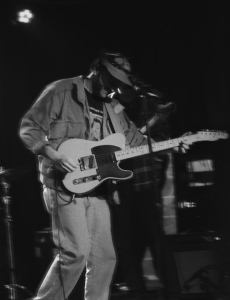
The man himself, during the interview, described the record’s sound as “song driven loud guitar music with some country vocabulary in there”, but ultimately, he had assumed that all he had created was a rock record. “When I made Gnawing at the Cord, I thought, this is a rock record. No one could possibly confuse this for anything other than a rock record. And then it came out, and people are just like, that alt country thing is alive and well.” I must say that I agree with the classification of much of this record as alt country, and with each track it expertly snakes along through the different domains of the nebulous genre. As part of his response to a question regarding how he would describe his sound, Burton attempted to chart the distant poles at either end of the genre of alt country: “alt country is so broad, you know, some people, when they say alt country, they’re referring to like, Sierra Ferrell, (…) what she’s doing is very, very, rootsy. There are specific traditional elements to it, a lot of like fiddles and acoustic instruments, that kind of thing. On the full other end of that spectrum would be like, Wednesday for example. Where it’s kind of just like rock music that acknowledges that country music exists.” He also cited other prominent figures in and around the genre who have profoundly influenced him in some way, which include big players like Wilco and Son Volt, along with ancestors to the genre like Neil Young, which he says are “the kind of stuff that’s just like inescapable in my taste. It’s like, whatever my musical instincts are, that’s the foundational kind of stuff that’s fueling whatever my instincts end up being musically.” This statement from Burton is essentially what I think lies at the core of any great artist’s creative engine: our inspirations form its many components, they lay the foundation which is then built upon by one’s own work as art is not created in a vacuum.
The power of this record lies in its capacity to evoke feelings of familiarity in the listener through sonic gestures to its inspirations. As I said before, this causes the songs to sound as if they have always existed — timeless. This is aided by its measured production choices, that is, it lacks the amateurish, DIY qualities found in some indie music, past and present; it also lacks the mechanical, plastic sheen that overlays most modern rock music and especially modern country music. Furthermore, there is a very palpable organic quality to the music, particularly when it comes to the tone of the guitars which are crunchy, fuzzy, and heavily, like the hum of some great big bee, especially in songs like the strutting “Thermal Fuse”, the mournful “Shining Ear to Ear”, and the bombastic closing title track. That last track especially stood out to me as it is the longest one on the album and it contains a few different movements. The first of which is vaguely reminiscent of the more upbeat and frantic Interpol or Joy Division tracks, before it masterfully transitions to a gargantuan, sludgy sound and then to a more sparse, folk centric sound that incorporates a fiddle. Those three are certainly the big standouts of the album, along with perhaps its most renowned song titled “Abbreviated”, which leans more heavily into a twangy rock sound that bears a passing resemblance to a lot of modern country, though its lyrics possess a delightful slacker rock irreverence: “they almost called me O.J. / But I was born in 94 / Imagine what my vibe would be / walking around abbreviated at the grocery store”. I must also praise the album’s length and cohesiveness: no track feels out of place or unwelcome, certain tracks stand above the rest, but the whole thing is a well-curated collection that comes in at a tight 41 minutes, which makes it very easy to listen to over and over and over again.
Ovven Music/Website
Outside of the music, I have thoroughly enjoyed watching Ovven’s organic rise in real time, watching the numbers on Spotify climb higher and higher and watching to see who else on the internet is discussing this great record. Commenting on this phenomenon, Burton said “It seems to be just a lot of word of mouth is taking hold, which is awesome (…) I funded the whole project myself. My marketing budget was $0, so all the growth that’s happened has just been from a few heads in the genre, who I think found it early and have maybe just been doing a lot of word of mouth for it.” I feel like this is something that is not seen as often these days, given the glut of artists — good, bad, and otherwise — who seem to have very powerful industry connections or relatives with boundless resources to artificially expediate ascents. But this is a real, honest to God, grassroots movement that acts mostly independent of Burton himself. I’ve certainly been known to sing his praises to my friends, family, coworkers, etc. because the music is just that good. This is an incredibly impressive debut that is vigorous and vital, at times heartfelt and sorrowful, yet also very funny. My hope is that Ovven can one day become a household name as the likes of Young, Tweedy, Molina, because I think he sure as hell has the talent and the passion to become a legend so long as he keeps the bangers coming.
9/10