Jonathan Bruce
READING TIME: 8 MINUTES
Gothic horror films have been a popular genre for nearly a century. Popular examples include the Universal horror movies Dracula, The Wolf Man, and Frankenstein. The latter has proven very successful over the years due to its focus on life, death, rebirth, and humanity. Written by Mary Shelley, Frankenstein, or The Modern Prometheus, was published in 1818 and has inspired countless sequels, remakes, and reinterpretations, such as the famed 1931 film adaptation starring Boris Karloff as a mostly-mute Creature. Some more recent takes on the mythos include Kenneth Branagh’s impressive yet operatic Mary Shelley’s Frankenstein (1994), and 2024’s Poor Things (starring Emma Stone). Of all these adaptations, the Branagh film comes the closest to adapting the original novel, but it never really taps into the essence of what makes the Creature tick. Perhaps it is true that certain works of literature are very difficult to adapt to film.
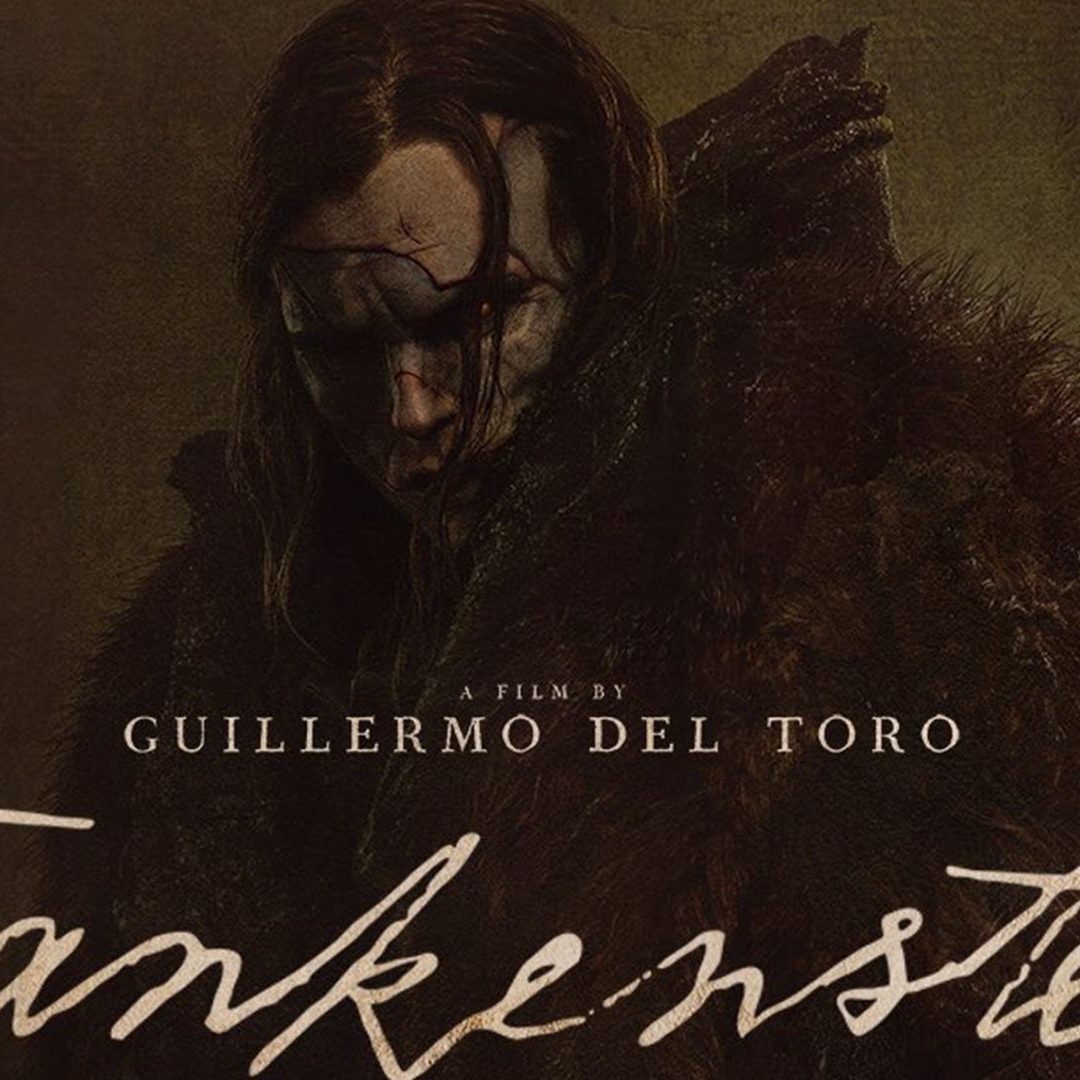
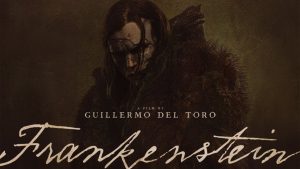
Guillermo del Toro’s latest film, Frankenstein, is the latest instalment in the Gothic horror genre. Produced for Netflix, the film is both directed and produced by the director, whose track record has included elements of horror and gothic in his work. The cast includes Oscar Isaac, Jacob Elordi, Mia Goth, Felix Kammerer, Lars Mikkelsen, Charles Dance, and Christoph Waltz. Although it appears to be a Gothic horror movie, del Toro aims for the story to be more of a drama film that focuses on the id and ego of Shelley’s famous characters. His goal has been to create an emotional story that explores human nature, which he has covered in past films such as Pan’s Labyrinth, Crimson Peak, The Shape of Water, Nightmare Alley, and Pinocchio.
Netflix
Opening in 1857, the Danish ship Horisant is heading on an expedition towards the North Pole before getting stuck in the ice. Captain Anderson (Mikkelsen) finds a weakened, injured man (Isaac) and has him taken aboard the vessel. A strange hulking creature (Elordi) attacks the ship and demands the man, Victor Frankenstein, give himself up. When Anderson shoots the being into the water, Victor reveals that he is responsible for the Creature and begins telling his story.
Victor was the eldest of two sons. His mother died in childbirth, and his younger brother William (Kammerer) became their father’s favourite. Baron Leopold (Dance) is cold and abusive to Victor, who’s left mourning his mother and having dreams of the “Angel of Death”. Upon growing up, Victor resolves to cure death and restore life via means of science. He goes to the Royal College of Surgeons at Edinburgh, Scotland to become a doctor, but various experimentations at reanimating corpses result in his being expelled. Following the expulsion hearing, he meets arms trader Heinrich Harlander (Waltz), who is intrigued with his research. Harlander offers the younger man funds and a tower to conduct his experiments in exchange for a single unknown favour. With the help of William, Victor begins his work anew with vigour. He’s also interested in Harlander’s niece Elizabeth (Goth), who happens to be engaged to William. Victor attempts to woo her romantically, but she turns him down.
After a week, Victor receives demands from Harlander to create a new living being. He resorts to using body parts acquired from dead criminals and fallen soldiers from the ongoing Crimean War. The reason for Harlander’s impatience is revealed: he is fatally ill with syphilis and wants his brain placed in a new, healthy body. Horrified by this knowledge, Victor refuses to honour such a request, which leads to Harlander trying to wreck the laboratory in a fit of rage and ends in him falling to his death. At that moment, lightning strikes the newly-assembled Creature, but it appears to have no effect. Or so it would seem.
Upon waking the following morning, Victor is stunned to discover the Creature is alive and mobile. His size is large, his strength is powerful, and he has a unique ability to quickly heal from wounds. Yet he appears to be brain damaged and can only say one word (“Victor”) that his creator has taught him. Angered by the lack of intelligence, Victor feels he has failed and starts emulating his father, all the while fearing what he has created. When William and Elizabeth come to visit, the latter meets the Creature and begins to teach him to speak, starting with her name. After William discovers the corpse of Harlander, Victor blames it on the Creature and sees them off. He decides to destroy the laboratory and the Creature by setting everything on fire, but hearing his creation call out his name makes him feel guilty. Victor tries to rescue the Creature, but he gets injured in the tower explosion, losing a leg in the process.
While Victor goes on with his life, the Creature is revealed to have survived and taken refuge on a local farm owned by a family. He remains hidden while providing his hosts with supplies and performing chores in secret. Although they don’t know who’s helping them, they believe a “Spirit of the Forest” is this mysterious benefactor. When the family goes off hunting in the mountains, the Creature reveals himself to their blind father (Bradley), who treats him with kindness and understanding. He is taught how to speak and read fluently under the older man’s tutelage. After returning to the ruined laboratory, the Creature discovers the means through which he was formed and the location of Victor’s estate in Geneva. Upon going back to the farm, he fights off a pack of wolves and defends the patriarch, who dies of his injuries. The man’s children return and shoot the Creature on the assumption that he killed their father. However, it emerges that his healing factor has worked too well: he cannot die and may be immortal. Fearful of being alone and desiring a companion, the Creature manages to track down Victor at the wedding of William and Elizabeth. He demands that a female creation be made for him, or else Victor will suffer the consequences. What follows is a tense battle of wills, desire, wrath, and tragedy.
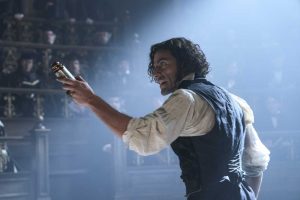
Oscar Isaac delivers a dramatic performance as Victor. He manages to capture the obsessive nature of the character, as well as the desire to conquer death and create life. Isaac excels at showing Victor’s driven, intense nature and his morally-conflicted nature. He also succeeds in depicting the poor choices of the character, such as Victor conducting unethical experiments, building a new being out of desecrated body parts, etc. The film also manages to show Victor’s irresponsibility to the Creature by rejecting and attempting to destroy it, as well as his refusal to take accountability for his actions. Despite being a solid twenty years older than the literary character, Isaac manages to portray Victor as an intelligent, albeit flawed man whose poor choices and refusal to take responsibility condemn him.
Netflix
It is Jacob Elordi’s performance as the Creature that commands special attention. The young actor has taken the role and made it his own. He is both unsettling and deeply moving to watch onscreen. In his earliest scenes, Elordi gives him a sense of physicality via animalistic body language and roaring, which does give off an unsettling feeling. Yet it is his attempts at learning and seeking companionship that are deeply memorable. Look no further than the scenes of the Creature struggling to adapt and live in a world that will not tolerate him. The moments of him learning how to read and speak under the blind man’s care are emotionally moving and quite heartfelt to watch. His reacting in horror to his own reflection is heartbreaking to watch, because his appearance is being reinforced as ugly and abhorrent. Elordi reacting to his own abilities and fearing the possibility of loneliness are among his best acting moments.

Netflix
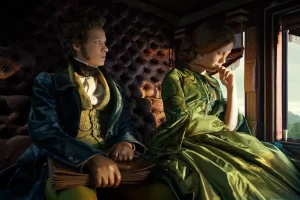
The rest of the cast does well in their roles. Mia Goth plays Elizabeth as a moral, good-hearted woman who treats the Creature with kindness. Unlike other versions of the Shelley narrative, she is not in a relationship with Victor, which gives this take more dimension. Felix Kammerer brings an air of common sense and reason to William, and his eventual denunciation of his brother Victor is quite gripping to behold. Charles Dance (Game of Thrones) continues to show his talent in playing icy, aloof authority figures by depicting Baron Leopold as being a cold, strict father. Lars Mikkelsen plays Anderson as a wily, hardened mariner who’s not afraid of the elements, but is only beginning to understand the horrors of what humanity can do. Christoph Waltz is compelling as Heinrich Harlander, but this is not the type of Waltz performance that people might be expecting. Initially appearing genial and supportive, he reveals himself to be driven by a dark secret that makes him both appalling yet sympathetic to viewers. Finally, David Bradley delivers a warm, genial turn as the blind man who treats the Creature with compassion. Having been known for playing disagreeable types like Argus Filch in Harry Potter or Walder Frey in Game of Thrones, the veteran character actor makes the most of his screen time as a kind person who is both welcoming and willing to give others a chance.
Netflix
Literary fans should be aware that del Toro’s Frankenstein is not a complete translation of Shelley’s novel. As par the course in Hollywood, there are some changes made to the source material, but these do not work against the movie. For example, rather than being an orphan, this version of Elizabeth is not the ward of Baron Frankenstein and thus does not grow up with Victor. Nor does she fall in love with Victor, despite the latter having romantic feelings for her. William is made closer in age to Victor in contrast of the novel’s depiction of them being nearly a decade apart, and he has more to do within the context of the story. In the novel, Victor simply drops out of medical school to work on his experiments full-time, but del Toro goes a step further by having him be expelled for the nature of his research. Henry Clerval, Victor’s best friend in the novel, is omitted from the film, and William serves as a morality pet and the voice of reason to Victor. The character of Captain Robert Walton is replaced with the Danish captain Anderson, which doesn’t take away from the narrative. However, del Toro’s decision to exchange captains causes depth to be taken away from the narrative, since Walton’s desire to reach the North Pole is a mirror counterpart of Victor’s obsessive quest. In addition, the Creature of this film is revealed to be immune to ailments and hurts, which suggests that he might be immortal. This stands in contrast to the Creature of the novel, who was shown to be wounded by fire and gunshots.
In terms of production value, the film is quite beautiful for viewers to behold. While most of the movie was shot in Toronto, Canada, filming also took place in Lincolnshire, England and Angus, Scotland. Cinematographer Dan Lausten uses a smooth, vivid way of filming the action and settings. As a result, the final cinematography work is equally strong, gloomy, and cinematic. It could even be compared to something right out of the 19th century. The score is conducted by composer Alexander Desplat, who aims for a deeper, more lyrical score than a traditional horror movie. His use of modern and classical influences make for a unique type of sound. In addition, Desplat incorporates music by Johann Sebastian Bach and Wolfgang Amadeus Mozart into the film, so as to further establish the period’s influences.
Overall, Frankenstein is an excellent film and a great work from del Toro. Although it does take some license with Shelley’s narrative, the movie is a deep, emotional take on the mythos and makes for a compelling story. Isaac, Elordi, Goth, Waltz, Dance, Kammerer, and Bradley give powerful performances. Desplat’s score is gripping, tense and moving. Five out of five stars.
SHARE