Jonathan Bruce
READING TIME: 9 MINUTES
Historical period dramas are a beloved film genre, especially when focusing on England. Some of the best known movies include Pride and Prejudice, Sense and Sensibility, Room With a View, Howard’s End, The Remains of the Day, and Atonement. More recently, the genre has expanded to television with shows such as The Tudors, The Crown, and Downton Abbey. Curiously, the success of the Downton Abbey series led to three feature films that continued the story of its protagonists. But when it comes to Shakespearian England, that is a tricky subject to tackle, especially given that a lot of younger generations aren’t as familiar with William Shakespeare or his classic works. Granted, viewers remember Shakespeare In Love, the amusing romantic-comedy that imagines how the Bard created Romeo and Juliet. While that film proved successful and won Best Picture of 1998, there have not been many movies about Shakespeare and the world he lived in. A few other films have been produced, such as the 2011 thriller Anonymous suggesting that Shakespeare might not have written his most famous plays. However, there has been no major films that examined what made the Bard function as a writer and as a man.
Hamnet is the latest period drama to tackle Shakespeare. Directed by Chloe Zhao (Nomadland, Eternals), the movie is based on the 2020 historical fiction novel of the same name by Ferrell. Both Zhao and Ferrell collaborated on the film’s screenplay. It concerns the complicated marriage and lives of William and Agnes Shakespeare during the early years of their marriage. The cast consists of Jessie Buckley, Paul Mescal, Emily Watson, Joe Alwyn, Justine Mitchell, David Wilmot, Bodhi Rae Breathnach, Olivia Lynes, and Jacobi Jupe.
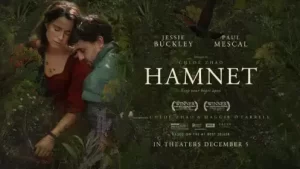
Focus Features
The film opens with Agnes Hathaway (Buckley) escaping her household chores to go walking in the forest. She’s the eldest child in her family, and she’s regarded by the locals as an oddity for her long walks and for practicing falconry with her pet hawk. Ever since her late father died, Agnes has been running the household for her stepmother Joan (Mitchell) and raising her younger step-siblings. One major source of comfort is her brother Bartholomew (Alwyn), who is essentially serving as her moral support and guidance. Although she has her brother’s love, Agnes is haunted by memories of her deceased mother Rowan (Louise Harland), who often appears to her in dreams.
Will Shakespeare (Mescal) is a young man working as a Latin tutor for local students. He hails from Stratford-on-Avon as the eldest son of glove maker John (Wilmot), whose debts have plunged the family into financial struggle. Will has been teaching Latin as a means of paying off said debt. When first meeting Agnes, he assumes she is a servant and becomes smitten with her feisty nature, but she tells him never to see her again. Later, he learns from his mother Mary (Watson) that Agnes is the daughter of Hathaway and is rumoured to be the child of a forest witch. Upon finding her again, Will slowly falls in love with Agnes after telling the story of Orpheus and Eurydice. Agnes does some palm reading of Will’s hand and experiences a premonition that he will be successful while she will have two children at her deathbed.
Not long afterward, Agnes becomes pregnant with Will’s child. This results in Joan disowning and expelling her from the Hathaway household. Agnes comes to reside in the Shakespeare family home. She and Will get married, and their eldest child Susanna arrives after Agnes gives birth out in the forest. Now a husband and father, Will is under even more pressure to support his growing family. John takes his frustrations out on Will refusing to do manual labour, which leads to a physical fight between the two. Determined to become a writer, Will has a case of writer’s block and finds it impossible to create anything. At Agnes’ suggestion, Bartholomew sends Will to London to try his hand at career on the theatre stage. Shortly thereafter, Agnes learns she is pregnant once more. Despite her stubborn desire to give birth in the forest again, her family insists that the child be safely delivered at home. Upon having a boy, she learns that she’s also carrying a second child. The baby, a daughter, has a rough delivery and appears to be stillborn. Although tradition is never to hold a stillbirth, Agnes demands to hold the baby and manages to get her breathing, which results in the child surviving.
Eleven years later, Will and Agnes are still happily married, but the former’s work in the theatre takes him away from home for weeks and months at a time. Susanna has become a bookish type, while Hamnet (Jupe) and Judith (Lynes) are rambunctious and sneaky. The twins enjoy playing pranks such as switching clothes and pretending to be each other, which their parents and Susannah find amusing. Will adores his wife and children, yet he agonizes over having to travel from home so often. Agnes finds his absences frustrating, which is putting a strain on their marriage. The plan is to find a new house and move the family there. Before any plan takes place, however, a terrible bubonic plague comes to England. Will is stuck in London and is unable to travel back home. Judith, a frail, sickly child, is the first of the Shakespeare family to fall ill, which distresses Agnes. When Hamnet tries to will his sister to live, he disregards the isolation rule and falls asleep with her. Although Judith recovers, this tragically results in Hamnet dying of fever, leaving Agnes and the girls distraught. Will returns too late and finds his son already dead, and he is devastated over not having been there.
In the wake of Hamnet’s passing, Will and Agnes’ marriage becomes deeply strained. Both find it extremely difficult to discuss their child, and they more or less separate after a bitter argument over the tragedy. Agnes remains with the girls, and Will decides to go back to London. Before leaving, he purchases the largest house in Stratford for Agnes and the girls, which he names New Place. Grief-stricken, Will returns to London and resolves to channel his pain into writing a new stage play, which he titles Hamlet. Yet the real question is thus: can Will and Agnes heal their inner wounds and move forward with their lives?
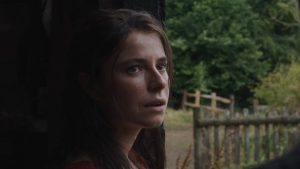
Jessie Buckley is excellent as Agnes. She depicts the character as being headstrong, fiery, and stubborn in pursuing her goals. Her gentlest moments are the early scenes of Agnes being won over by Will and slowly falling in love with him. Perhaps the most difficult scenes are those of her giving birth; the former is done in the forest, while the latter is a tense home birth in which one of the twins nearly dies. Buckley’s tour-de-force take on the character keeps Agnes front and center for the majority of the plot. While Shakespeare is a focus in the film, Buckley is essentially the main protagonist of this story.
Focus Features
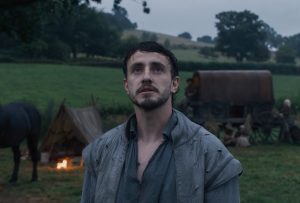
Paul Mescal delivers a quietly moving turn as Will. His charismatic, likeable nature provides a stark contrast to Buckle’s strong-willed performance. Unlike his past roles of a beefcake nature (such as Gladiator II), Mescal has to convey emotions via body language and periods of silence. His best scene comes in the third act, where he recites the famous “To be or not to be” monologue from Hamlet. It is not ham-fisted or over-acted; rather, the moment is somber and deeply heartfelt. Another heart-wrenching scene is his giving notes to actors at the Globe Theatre on injecting passion and meaning into their lines.
Focus Features
The rest of the cast does well in their supporting roles. Emily Watson provides a maternal source of comfort and wisdom as Mary Shakespeare. Her best scene is a quiet fireside conversation where she recalls losing three daughters at young ages; one died at eight years old while the other two were infants. It is a deeply sad, nuanced moment that shows how mortality was a very real concern and a danger to newborn babies. Joe Alwyn delivers a subtle yet supportive turn as Bartholomew, and he is the only one in the Hathaway family who supports his sister. David Wilmot brings a disgruntled, world-weariness as John Shakespeare, and his best scene occurs during a fight with Will over not wanting to be a glove maker. Justine Mitchell comes the closest to being the film’s antagonist during repeated attempts to dissuade a pregnant Agnes not to marry Will, as well as disowning her. Bodhi Rae Breathnach is amusing as Susanna Shakespeare in attempting to read while reacting to her siblings’ mischievous antics, but even she gets in on the fun by reenacting the Weird Sisters’ scenes from Macbeth. Olivia Lynes is moving as Judith Shakespeare in her expressing misplaced guilt over the tragic death of her brother. Jacobi Jupe proves to be a delight as Hamnet, especially in pulling pranks with Judith and his playful roughhousing with Will. His most heartfelt scenes include voicing concern about being separated from his father and trying to get his sister to snap out of her sickness. Perhaps most amusing is the casting of Noah Jupe (Wonder, A Quiet Place, Ford v Ferrari) as the actor playing Hamlet in the first ever performance of the play. He is the older brother of Jacobi, and it serves as a glimpse of what Hamnet could have been like as an adult. Although not in focus during his early scenes, the older Jupe takes centre stage during the third act and proves himself capable as an adult actor.
Par the course in Hollywood, there is a bit of artistic license taken with Hamnet for dramatic effect. Shakespeare’s wife was known as Anne Hathaway, although she is referred to as “Agnes” (pronounced Ann-yes”) in the novel and the film. Surviving historical records of that era have shown she was referred to as both Anne and Agnes throughout her life. Furthermore, the prologue states that names like “Hamnet” and “Hamlet” were considered one and the same. In the movie, Will and Agnes are depicted as being roughly the same age upon their first meeting, whereas in real life, the latter was nearly eight years older than her future husband. Zhao’s film depicts the Hathaway and Shakespeare parents expressing disdain over an unplanned pregnancy; the former are more concerned with Agnes’ honour. Will’s mother is adamant about the baby being born legitimate, and this leads to their marriage. Although some viewers might call it a shotgun wedding, it must be remembered that hand fasting was a common betrothal method that had legal standing during Shakespeare’s time. If the hand fasting had official witnesses, it was considered binding as a contract, but any children born before marriage would not be considered legitimate. Furthermore, pregnancies between unmarried people was not uncommon back then.
Focus Features
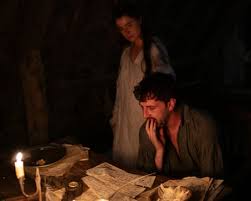
The narrative presents the idea that Will channelled his grief into writing the play Hamlet, so as to connect with his deceased son and get closure over not being there at his passing. Yet it should be remembered that a major influence on the play was the Scandinavian legend of Amleth. Unlike Shakespeare’s Hamlet, Amleth is a Viking saga of revenge and triumph, but that story has variations and differs greatly from Shakespeare’s Hamlet. Another possible source is an earlier lost play titled Ur-Hamlet, which may have been written by Shakespeare or even Thomas Kyd. Moreover, the film depicts Will creating Hamlet in the year following his son’s death, but in reality, there was a four year gap between Hamnet’s passing and the play’s premiere. While Ferrell’s novel and the script take some dramatic license, it is not impossible that Will and Agnes’ grief had a factor in the creation of Hamlet.
With regard to production, the film is very cinematic while keeping a focus on the characters. As is a trope of Zhao’s movies, there are an abundance of nature shots in pastoral settings, such as the wilderness of Herefordshire, England. The town of Weobley is used to depict Stratford as it looked during Shakespeare’s existence. In addition to Herefordshire, the film also depicts sixteenth century London, which is brought to life in vivid detail. Designer Fiona Crombie has recreated a replica of the famous Globe Theatre for the film’s third act, and the result is like something out of a historical documentary. Łukasz Żal’s cinematography work is shot in a cinema verite style, which is vivid and beautifully-shot. Literary fans and scholars will no doubt find Hamnet amusing for its use of period-authentic Old English dialogue. The film uses quotations and translations from the Nine Herbs Charm from the tenth century. Philologists Joseph S. Hoskins and Stephen Pollination are cited in the film credits for the use of their translations.
Overall, Hamnet is a brilliant work of art. Zhao succeeds in delivering a human story and focusing on characterizations while retaining brilliant production design. Buckley, Mescal, Watson, Alwyn, Mitchell, and Jupe deliver excellent performances. This is one of the year’s best motion pictures. Five out of five stars.
SHARE