Will Foley
READING TIME: 4 MINUTES
Prior to watching Heated Rivalry, my experience with the BookTok canon was incredibly limited. I know of certain renowned, beloved, and at times controversial authors made popular by those in this space, such as the romance writer Colleen Hoover and romantasy writer Sarah J. Maas. There are also the mostly well-respected elder stateswomen held up as inspirations, such as Stephanie Meyer and E.L. James. However, I only know of many of these novelists through certain friends of mine who are fans, the discourse on literary subreddits, and certain channels on YouTube such as Krimsonrogue. This space is primarily dominated by young women, and I am a snobbish young male English major; so, needless to say, much of the content produced by and for the people of BookTok does not really appeal to me and I understand that it’s not really supposed to.
By that same token, I was not at all interested in watching Jacob Tierney’s Heated Rivalry, an adaptation of the first and second books from Canadian novelist Rachel Reid’s Game Changers series: hockey-themed romance novels that came to prominence within the BookTok scene. In fact, this series sounded like my personal hell when it was first described to me, and not for the reason that you may think a cis white fella would dislike it (the great big pink elephant in the room: the gay aspect). This sort of thing does not bother me at all; in fact, I have unequivocal support for the telling of queer stories. I am unashamed to say that Brokeback Mountain made me cry like a baby, I am a longtime fan of RuPaul’s Drag Race, and The Picture of Dorian Gray is one of my favourite books of all time. I am no stranger to queer media, and the inclusion of passionate gay romance in works of art does not dissuade me from engaging with them.
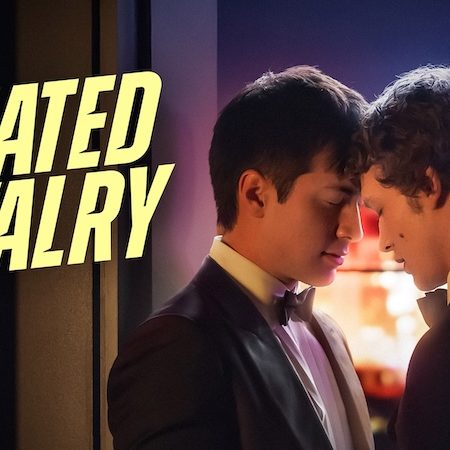
Heated Rivalry Poster (Crave)
My issue prior to watching it was mainly with the fact that it was described to me as “smut” with the hockey merely as a backdrop (as someone who is at best indifferent to hockey, I was totally okay with this). When applied to a particular work, this signifies to me that it will be frivolous and bereft of thematic and emotional depth and that the characters will all be flat archetypes that are static and unrealistic. For example: the hunky Byronic paramour seduces the reserved, naïve, sexually repressed and/or occasionally dorky guy or gal — pages and pages of steamy exchanges without merit or purpose ensue. My girlfriend is not typically a fan of this kind of media either, though she is far more amenable to such things than I; therefore, she was more easily convinced by her friends to give it a shot. Subsequently, she set to work on me, and after days of wearing me down and some threats to strap me to a chair with my eyelids held open à la A Clockwork Orange, I gave in and watched it with her.
What I first noticed in my viewing is that this show is no different in terms of setup and characterization. The reigning convention that I established is almost exactly what plays out in episode 1 when Ilya, the brooding and laconic Russian, seduces the sexually repressed and dorky Shane Hollander in the showers after working out, sparking their passion. At the outset, the speed at which the relationship developed seemed far too quick and I found it to be somewhat unrealistic. “Where else could they go from here if they already got busy in the first episode?” I thought to myself. However, as the show progressed, I was completely proven wrong.
The relationship between Shane and Ilya begins as an entirely carnal arrangement and it remains so for many years. However, throughout these years we see glimmers of the romance that both of them desire, but cannot truly have. The main reason for Ilya specifically is the homophobia of the Russian government which punishes openly queer individuals severely. This includes his own father, who fosters a fear within him that follows him all the way to North America. Additionally, there is the latent homophobia of professional sports. This is particularly pernicious in professional hockey as, unlike the NBA, NFL, and AHL, there are no openly gay players within the NHL, despite there being no rule against such a thing.
This framework contextualizes the purely sexual nature of their relationship as a necessity. Ilya and Shane have these desires, but they mustn’t express such things openly. They resort to clandestine meetings in hotel rooms and eventually their own homes. This is until Scott Hunter — captain of the New York Admirals — publicly professes his love for his estranged partner Kip upon winning the Stanley Cup (the MLH Cup in the show). This blows open the closet that hides his true nature in a truly moving and tearjerking display. Hunter emboldens the two heroes to pursue a true romantic relationship, not solely as sexual partners, and this feels truly earned as we spent the previous episodes watching their struggle to decide what they truly want out of life and this relationship.
I could go on for much longer, but I think that it would be a disservice to the great work done by Jacob Tierney, Connor Storrie, Hudson Williams, and all others involved. This is a truly tremendous show, and I haven’t even said a thing about its cinematography, colour-grading, or set design. I sing its praises most ardently in that realm as well, especially since from what I’ve heard, the budget was incredibly small. At any rate, if you are interested enough in the show to read this article and you haven’t yet watched it, you must do so immediately as, coming from a fellow that usually dislikes this stuff, this show is a must-watch.