Jonathan Bruce
READING TIME: 6 MINUTES
Science fiction is a tough genre of film to crack. There are some movies that have proved very successful and influenced the genre, such as 2001: A Space Odyssey (1968), Star Wars (the original 1977 film), The Matrix (1999), Inception (2010), Interstellar (2014), and the recent Dune movies. Yet for every success, there are many more cinematic misfires such as Battlefield Earth: A Saga of the Year 3000 (2000), Stardust (2007), John Carter (2012) and Jupiter Ascending (2015). A number of reasons for flopping are due to limited marketing, story problems, poor direction, hammy acting, or simply adding nothing new to the genre.
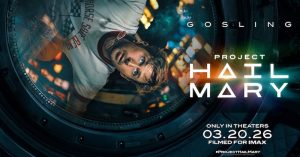
Into our midst comes Project Hail Mary, the latest film directed by the duo of Phil Lord and Christopher Miller (and written by Drew Goddard). Based on the 2021 novel by Andy Weir, the cast consists of Ryan Gosling, Sandra Huller, James Ortiz, Lionel Boyce, and Ken Leung. The film has been lauded by critics and audiences as one of the year’s best works. Now the real question remains: does the film succeed on its own terms as a science fiction story?
Lord Miller Productions and Pascal Pictures.
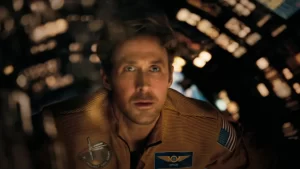
Astronaut Ryland Grace (Gosling) wakes up from an induced coma to find himself on an interstellar craft. Due to retrograde amnesia, he has no memory as to who he is, how he got on the spacecraft, or what has happened. It soon emerges that two other astronauts have died and the craft is many light-years away from Earth. As he regains his memory, Grace recalls his life as a middle school science teacher and molecular biologist. He previously worked at a university before losing his job due to teaching theories about life not requiring liquid water, and then went to teach in the public school system. The reason for his presence on the space mission was due to a project to study the dimming on the Sun and development of an infrared line known as the Petrova line. Due to the dimming, government agent Eva Stratt (Huller) selected Grace and other scientists to go into space to study the phenomenon known as astrophage, which are microorganisms growing across the surface of the Sun. After a training exercise kills a scientist and the backup crew, Grace is bumped up to a spot on the mission. While Grace refuses to go, he ends up drugged and forcibly placed on the spacecraft against his will.
During the voyage, Grace learns about the Petrova line and discovers that astrophage are single-celled alien organisms that absorb energy from stars. Furthermore, these organisms are impenetrable to electromagnetic radiation. They can serve as an effective source of fuel, but, on the flip side, they are also very volatile in nature. According to Stratt’s briefings, the astrophage have been infecting various stars within the Solar System. Grace’s spacecraft, also known as Hail Mary, is on a suicide mission to the lone undimmed star known as Tau Ceti.
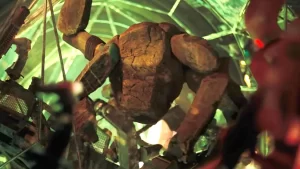
Upon approaching Tau Ceti, Grace observes an alien spacecraft that docks with the Hail Mary. He meets the pilot of the vessel, which is a five-legged rock-covered alien whom he nicknames “Rocky” (James Ortiz). It is revealed that Rocky is from a planet called 40 Eridani and can see through the process of echolocation. Upon building a translation device, Grace manages to communicate with Rocky, who is on a similar mission to prevent astrophage from spreading. The two follow the Petrova line and discover the Tau Ceti e planet has an organism that feasts on astrophage, which can control them from multiplying. As they begin collecting the organism, an unexpected fuel leak on the spacecraft leads to a near disaster and a fateful decision that Grace has to make.
Lord Miller Productions and Pascal Pictures
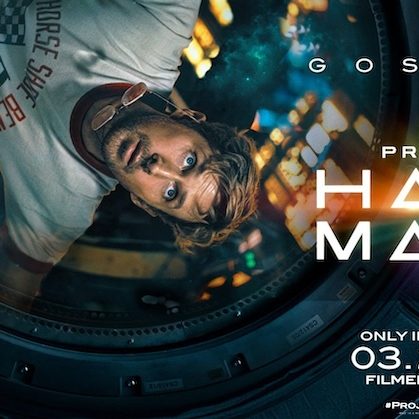
Ryan Gosling delivers a dramatically moving performance as Grace. While known for giving stoic performances like in Drive (2011), Blade Runner 2049 (2017), and First Man (2018), the actor brings a more nuanced, vulnerable side to the character. In the film, Grace initially comes off as cowardly and indecisive at first, yet gradually grows into the role of a leader. His best scene comes when he realizes that his crewmates did not survive the trip through space, which leads to him giving them a somber eulogy and burial in space. It stands as one of Gosling’s finest moments as a leading man.
Lord Miller Productions and Pascal Pictures.
The rest of the cast does well with the material. Sandra Huller brings a toughed, no-nonsense demeanour to the role of Stratt. While she comes off as a hard type, the actress makes her character visibly troubled by some of her morally dubious actions. Huller brings a layered uncertainty to Stratt, especially when having to make a hard decision. Ultimately, the film’s biggest surprise is that of James Ortiz, who delivers an interesting turn as Rocky. By his own admission, Ortiz is a puppeteer and doesn’t consider himself an actor. Yet his physicality and unique body language make Rocky a memorable character. Ortiz’s blunt, direct way of speaking is also a nice contrast to Gosling’s quiet stoicism.
As filmmakers, Lord and Miller excel at keeping the characters and plot at the forefront of the movie. This is an advantage for the film, because other science fiction stories tend to get lost in visuals and set pieces. Having previously dipped into the genre with Solo: A Star Wars Story, the duo are adept at balancing the characters and conflict. This serious approach to the film’s storytelling is especially unique for both directors, since they originally came from a comedy background.
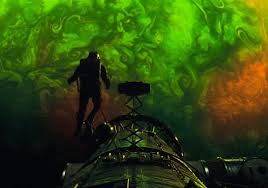
Perhaps most impressive is the film’s use of special effects and puppetry. Audiences will be intrigued to learn that no green or blue screens were used in the production, because Framestore aimed for an organic look to the story. Filmed in IMAX with Arri Alexa 65 cameras, the film is shot in an aspect ratio of 2:1:1 and 6.5k resolution, which gives the finished product a very cinematic look. The Hail Mary spacecraft was created as a physical set from the ground up and with practical lightning for exterior shots. Rather than simply relying on CGI and motion-capture, the practical effects and puppetry used on the creation of Rocky are the standouts of this movie. Proper credit must be given to Neil Scanlan and his team for creating animatronics in bringing the character to life, and only minimal CGI was used in the final product. Despite Rocky not having an actual face, the character comes off as a believable, intriguing being. Instead of using CGI, the exterior shots of space were made with black backdrops.
Music is also a vital part of the film, and the most apt word to describe it would be “ethereal”. Daniel Permberton’s compositions are a mixture of organic materials, glass harmonica, cristal basket, ondes Martenot, and synchronized “body percussion” to create a humane type of score. Most notably, the composer uses a woodblock and various instruments over a particular eight-minute sequence. The film also uses an eclectic number of songs by popular artists, such as Harry Styles’ “Sign of the Times”, Ella Fitzgerald’s “Let’s Call the Whole Thing Off”, The Scorpions’ “Winds of Change”, Kris Kristofferson’s “Sunday Mornin’ Comin’ Down”, The Beatles’ “Two of Us”, and Neil Diamond’s “Stargazer”. In addition, there are also some lesser known tracks, such as Dennis Wilson’s “Rainbows”, Bill Conti’s “The Final Bell”, “and Ornella Vanoni’s “E Cosi Per Non Morire”. All in all, these songs make a compelling, unique type of atmosphere for the film.
Lord Miller Productions and Pascal Pictures.
If anything, the film struggles by not explaining certain plot points, which leaves things not clear at times. For instance, a lot of the novel’s hard science is not included, so it’s never fully revealed how the astrophage store energy or how it is converted to fuel. Nor does the viewer get any exploration into Rocky’s species or biology. At two hours and thirty-six minutes, the film does drag on at times, but editor Joel Negron keeps things moving at a swift pace.
Overall, Project Hail Mary is an impressive, compelling movie and science fiction story. Lord and Miller succeed in delivering a narrative that is both intriguing and moving to watch, especially with the mystery angle of the film’s first half. Gosling shines in a worthy lead role, which proves he is one of the best actors of this century. Ortiz and Huller also turn in impressive performances. Four out of four stars.
SHARE


Good Night and Good Luck Delivers an Impressive, Intimate Look at The Media