Jonathan Bruce
READING TIME: 8 MINUTES
Foreign films are a unique brand in themselves. Produced outside of America and away from the confines of Hollywood, these works vary in terms of style, content, and aesthetics. Initially being seen as a unique genre, foreign language movies grew to be more than just an art form and became their own category. They were initially their own independent niche and saw limited releases (if any) in North America, but in time, these films gained critical acclaim, commercial success, and various accolades from film guilds and associations. However, several mainstream audiences unfamiliar with foreign films disliked the idea of having to read subtitles imposed on the screen while watching. Early foreign filmmakers that made an impact in North America were Ingmar Bergman, Frederico Fellini, François Truffaut, and Akira Kurosawa. The 1980s, 1990s, and 2000s saw international movies such as Fanny and Alexander (1982), Les Reservoir Enfants (1987), Crouching Tiger, Hidden Dragon (2000), and Downfall (2004). In the 2010s, however, foreign films such as Amour (2012), Roma (2017), Parasite (2019), All Quiet On The Western Front (2022), and The Zone of Interest (2023) took the world by storm and won Academy Awards. Clearly, these types of films have proven that audiences can enjoy a movie that uses another language, but it makes one wonder what the next successful foreign film will be.
Sentimental Value is the most recent answer to that question. Directed by Joachim Trier, the movie is an intimate character drama that focuses on themes of art, generational trauma, emotional distance, the importance of legacy, family bonds, and the power of memory. It was co-written by Trier and screenwriter Eskil Vogt. The cast includes Renate Reinsve, Stellan Skarsgård, Inga Ibsdotter Lilleaas, Elle Fanning, and Anders Danielsen Lie. Most recently, the movie won the Academy Award for Best International Film. Ultimately, this begs the question: does this film really deliver the goods?

Mer Film, Eye Eye Pictures, and MK Productions
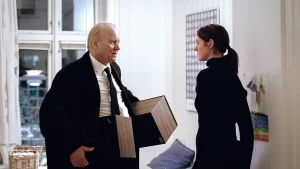
The film centers on a Norwegian family in Oslo. Gustav Borg (Skarsgård) and his wife Sissel (Ida Marianne Vassbotn Klasson) raised two daughters before they decided to end their unhappy marriage. Following the divorce, Gustav opted to leave Norway and devote himself to his career as a film director. Although he’s emotionally unable to open up to his family, Gustav is able to collaborate with actors and crew members, even going so far as to offer encouragement and support to them. Sissel, a psychotherapist, stayed behind in their Oslo home to raise her daughters Nora and Agnes. Being the elder sister, Nora shielded Agnes from the dysfunction of their parents’ marriage. The house has been in Gustav’s family for multiple generations, and it is said to be of great value to him.
Years later, Agnes has become a historian, enjoys a happy marriage to Even (Andreas Stoltenberg), and is raising a son, Erik (Øyvind Hesjedal Loven). Nora is an acclaimed stage actress, but she struggles with periods of stage fright. She’s also in a relationship with theatre colleague Jakob (Danielsen Lie), who’s married but in the process of divorcing his wife. After getting through a bout of stage fright before a theatre performance, Nora learns that their mother has just died. Upon learning of Sissel’s death, Gustav returns to Oslo for the first time in years so he can reclaim the house. Both Nora and Agnes are less than happy about his long absences from their lives, ongoing battle with alcoholism, and distant personality. Gustav tries to mend fences with his daughters, but his lack of emotional intelligence in reading the room and his microaggressions make this reconciliation attempt futile. Despite acting in one of her father’s films as a child, Agnes does not think much of Gustav or his career. Meanwhile, Nora is frustrated by Gustav’s dismissal of her career as a stage actress, because he doesn’t care for theatre and feels his daughter is wasting her talent performing in plays that are hundreds of years old. However, Gustav does have some success in bonding with his grandson Erik, but his decision to give age-inappropriate DVD films to the nine year old boy is questionable at best.
Now in his old age, Gustav feels he has lost his edge as a filmmaker and worries about being an elderly man. He is also finding it increasingly harder to secure financial backing to get his films made. One passion project that Gustav dearly wants to make is “Hemlangtan” (Homesickness), a semi-autobiographical history drama based on the life of his mother Karin, who took part in the Norwegian resistance movement during World War Two, fought the Nazis, was captured and tortured by the Germans, and committed suicide in the family home. She died when her son was seven years old, and the trauma of this memory has weighed heavily on him for years. Gustav has long been dreaming about doing the film as a tribute to his mother, and he specifically wrote the role of Karin with Nora in mind. What’s more, he even plans to shoot parts of the movie in their family home.
Mer Film, Eye Eye Pictures, and MK Productions
Seeking a chance to improve his fractured relationships, Gustav offers the role of Karin to Nora, but she flatly turns the offer down without even bothering to read the script. While attending the Deauville American Film Festival, Gustav becomes enamored by the American actress Rachel Kemp (Fanning), to whom he offers the role. This immediately sparks the interest of Netflix, who agree to finance the movie largely as a means of capitalizing on Rachel’s rising star power. Despite getting the film into production, though, Gustav chafes at having to collaborate with Netflix and cede total creative control. He’s also becoming bothered by the notion of the film being streamed internationally rather than getting a traditional theatrical release. Gustav tries to hire an old friend and retired colleague as the cinematographer for his film, but things end badly when he sees the man walking with a cane and begins feeling his own age. Production on the film becomes more complicated due to Rachel’s inability to speak Norwegian and her feeling nervous about playing the role.
As filming of the movie begins, Gustav attempts to make things less complicated by translating the screenplay into English for Rachel, but this only serves to make her even more insecure about the part. Nora observes Gustav showing Rachel more empathy than he ever did for her and Agnes, which fuels her resentment towards him. Gustav casts Erik in the film as the child version of himself, but this angers Agnes since she never granted him permission. When Jakob’s divorce is finally granted, this leads Nora to hope they can finally be together, but she is deeply saddened upon learning that Jakob will not fully commit to her. Nora attempts to confide in Gustav, but he only succeeds in upsetting her by saying internal rage keeps true happiness from ever happening. After a difficult day of production, Gustav gets drunk and passes out, which results in his being taken to the hospital.
Meanwhile, Agnes decides to conduct research on her family history as a way to understand what really makes Gustav tick. She begins pouring over historical transcripts at the National Archives of Norway and discovers her grandmother Karin was indeed tortured by the Nazis, an incident which she never talked about with anyone else. This leaves Agnes deeply shaken and realizing that Gustav inherited general trauma from his mother. Now, she resolves to convince Nora to see their father for who he really is, but to do so, Nora will have to come to terms with their past.

Mer Film, Eye Eye Pictures, and MK Productions
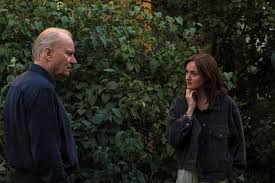
Renate Reinsve gives a powerful, emotionally-stirring turn as Nora. The actress manages to make her character a believable and nuanced individual who’s struggling with her past and her complicated family dynamics. In the opening scene, she manages to depict a panic attack before going onstage, and it showcases the anxieties that millions of people face in everyday situations without going into camp territory. Reinsve also excels in conveying emotion without speaking, and this is used in her scenes opposite her onscreen family. Her devastation over being snubbed and brushed aside by an emotionally unavailable colleague hits very hard for anyone who’s ever been let down in a relationship. In a tense yet heartfelt sequence, she commiserates with Agnes over their childhoods, bitterly wondering how she became messed up while her sister seemingly fine — only to re-examine her point of view from a whole other perspective.
Stellan Skarsgård delivers a quietly moving performance as Gustav. Previously having starred in dramas (Good Will Hunting), historical epics (King Arthur), comedies (Mamma Mia!) and action-adventure (Thor), the veteran Swedish actor continues to showcase his acting range in the role of a conflicted father who means well, but doesn’t know how to open up to others. Skarsgård conveys a lot of his character’s inner conflict via body language and long silences, which say just as much as any scripted words could convey. One of his best moments comes when Gustav gives praise to Rachel and gently reassures her of a choice she has just made. This is a quiet yet powerful scene, and Skarsgård plays it with an effective, understated manner. Sometimes, the most memorable roles are not played with gusto, long speeches or overdramatic gestures, because silence and minor tics prove to be quite meaningful.
Mer Film, Eye Eye Pictures, and MK Productions
Inga Ibsdotter Lilleaas offers a level-headed portrayal as Agnes. Despite being a supporting player, she brings a mature, well-rounded turn as the reliable sibling to Reinsve’s insecure big sister. Ibsdotter Lilleaas really shines in the second and third acts, as she goes from emotional distance to annoyance to anger to confusion and finally understanding. In one of the film’s most moving scenes, she shows her true self when expressing gratitude towards Nora for always being there for her, and it is both heartwarming and heartbreaking to watch.
Elle Fanning is in fine form as Rachel Kemp. Having started in Hollywood as a child star, she manages to portray her character as a talented, yet self-conscious, actress. Perhaps her shining moment in the film is when Rachel questions her being cast in the film and realizes that she might not be the right person for the role, due to it being too personal for the director. Fanning succeeds in taking what could have easily been a generic supporting role and bringing depth and real gravitas to her performance.
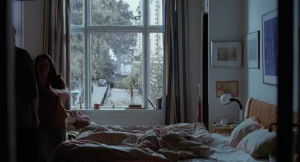
The film’s production values are quite impressive to behold. As a director, Trier keeps the story grounded in realism while keeping his characters at the forefront of the movie. One of his wisest moves is to set a good portion of the narrative within the Borg family house, and this choice almost makes the domicile feel like a character in its own right. Viewers will become familiar with various rooms, nooks, and crannies within the household, but these take on more meaning and certain revelations come to light as the story unfolds. Cinematographer Kasper Tuxen proves himself to be an effective Director of Photography, as he manages to effectively transition from the present day to the 1920s and 1930s without any abruptness. Tuxen’s modern day sequences are shot in 35 mm film, while all of the flashback sequences are done in 16 mm. Olivier Bugge Coutte’s editing work keeps the film moving at a smooth, steady pace. Clocking in at a brisk 133 minutes, the final product feels neither short nor overlong. As with most films, music is a vital part of this story, and composer Hania Rani brings an acoustic, minimalist feel to the work. Rani’s score is a subtle, nuanced sound with various rearrangements, reorchestration and ambient influences. As a result, the finished product is complex, vulnerable, and melancholic.
Mer Film, Eye Eye Pictures, and MK Productions
Overall, Sentimental Value is a solid film, and it is not hard to see why the movie won last year’s Oscar for Best International Film. Trier’s story and direction are both powerful and gripping. Reinsve, Skarsgård, Fanning, and Ibsdotter Lileeaas give excellent performances. Tuxen’s cinematography work is a highlight of the film, and Rani’s musical score is another beautiful gem. Four out of four stars.
SHARE




Good Night and Good Luck Delivers an Impressive, Intimate Look at The Media