Jonathan Bruce
READING TIME: 6 MINUTES
Joel Edgerton is a rare breed in Hollywood. After his early years at attempting to develop action star status, the Australian thespian has carved out a unique niche for himself in the film industry — that of a respected character actor. He has appeared in dramas such as Warrior (2011), Zero Dark Thirty (2012), The Great Gatsby (2013), Loving (2016), and The Green Knight (2021). Edgerton has also dabbled in filmmaking; his two directorial works are The Gift (2015) and Boy Erased (2018). Now, he returns to cinema as a leading man, and it is one of his more layered performances to date.
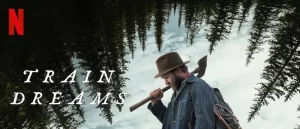
Train Dreams is the latest film to be produced exclusively for Netflix. Based on the novella by Denis Johnson, the movie is directed by Clint Bentley, who also co-wrote the script with writer Greg Kwedar. In addition to Edgerton, the cast includes Felicity Jones, Clifton Collins Jr., Nathaniel Arcand, Kerry Condon, John Diehl, William H. Macy, Alfred Hsing, and Paul Schneider. Veteran character actor Will Patton provides a voice-over narration to guide the plot. It has been released to critical acclaim and several accolades, including four Academy Award nominations for Best Picture, Best Adapted Screenplay, Best Cinematography, and Best Original Song.
Netflix
The film covers eighty years in the life of one Robert Grainier (Edgerton). Opening in the early 1900s, Robert lives and works in Bonners Ferry, Idaho. His true origins are shrouded in mystery; all that is known is that he was orphaned in his youth and arrived via train in the Midwest. Robert quits school and drifts through life without any plans or thoughts of his future. He meets a woman named Gladys Olding (Jones) and falls in love with her. The two get married after three months, construct a log cabin, and raise a daughter whom they name Kate. Robert gets a job working in railway construction for the Spokane International Railway to support his family. During this time, he sees racism firsthand as a Chinese rail worker Fu Sheng (Hsing) is tossed off a bridge by white men. The incident leaves a deep impact on Robert, who feels guilty for his failure to intervene on the man’s behalf. He quits soon afterward and takes up a seasonal job as a logger, but this takes him away from his wife and child for long stretches.
While working in logging, Robert encounters a lot of hardships. One coworker is murdered by a vigilante seeking revenge for the death of his brother. A number of other colleagues get crushed to death by a collapsed tree. His best friend on the team is Arn Peeples (Macy), who suffers severe injuries from a fallen tree branch and dies from his wounds. Determined to get home, Robert plans to change careers. He and Gladys devise a plan to start a farm and create their own lumber mill, which would give them financial independence and stability. Just when it appears he’s done with season logging, Robert suffers a horrific tragedy when a wildfire sweeps through the area, leaving him devastated and his dream in ruins. He remains in the area, not moving forward or pursuing any new connections.

Netflix
As time passes, Robert realizes that the world is evolving. His new colleagues are much younger and adept to change, and newly-invented technology is becoming popular. It becomes painful apparent that Robert has fallen behind with the times. Upon taking a new job as a carriage driver, he meets a forestry services worker named Claire Thompson (Condon), who is doing a survey on the area. The two open up and converse over their losses. It emerges that Thompson lost her husband after he suffered from severe illness, and she can empathize with Robert’s grief. Yet the big question remains: can Robert find the will to go on living?
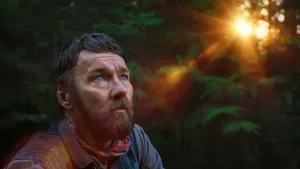
Edgerton’s performance as Robert is one of his finest outings as an actor. His best moments come from the most quiet ones of Robert living like a hermit in solitude. There are no loud, dramatic scene-chewing monologues or long-winded speeches. Instead, the most powerful moments are the quiet, subtle scenes where Edgerton is left reflecting on his thoughts. The most compelling moment is encountering the ghost of a man he saw murdered years earlier, and his simple declaration of “why” is heartbreaking to behold. The actor relies on his body language and stoicism to channel the feelings of grief, loneliness and uncertainty. Unlike other films that would overdo narration or character monologues, Train Dreams aims for the subtext — i.e., that which is not being spoken — to carry the story. Edgerton is really good in this film, and it is mind-boggling that he was overlooked by the Academy for his role.
Netflix
The rest of the cast does well in their roles. Felicity Jones plays Kate as a loving, supportive woman devoted to her husband and daughter. Her presence is a calm, soothing one, and she helps drive Robert’s dream and remains a fixture on his mind. Kerry Condon brings a solid, reliable demeanour to Claire, and she is one of the more stronger performers in the film. Some of her lines are among the movie’s most memorable, such as “The world needs a hermit in the woods as much as a preacher in the pulpit” or “The dead tree is as important as the living one”. Paul Schneider beings a pious, moral type of being to Apostle Frank, and it leaves the viewer wondering how much of this character’s behaviour is genuine or feigned. Alfred Hsing plays Fu Sheng as a Chinese labourer who finds it difficult to work in America while dealing with prejudice and a language barrier, and his fate is both tragic and unsettling to watch. Perhaps the most impressive performance among the ensemble is that of William H. Macy’s demolitions expert Arn Pepples. Although we don’t learn much about him, the character is shown to be quite knowledgable about munitions and history, particularly those concerning the American Civil War. The veteran actor is only in a handful of five scenes, but he makes the most of his screen time with a deep philosophical outlook on life. As always, Macy is a pure delight to watch onscreen. Despite Will Patton never physically appearing onscreen, his narration is a grounded, relatable perspective that taps into Robert’s psyche while describing the old world depicted in the film.
In terms of production values, Train Dreams is beautifully-shot and well-staged. Editor Parker Laramie keeps the film moving along at a brisk pace of one hour and forty-minutes, and it never feels long, plodding, or meandering. If one word could be used to best describe the film, it would undoubtedly have to be authenticity, since Bentley keeps the story grounded in gritty realism and period authentic settings. Cinematographer Adolpho Veloso shot the film on digital photography, and the result is something that looks right out of the early 20th century. The visual influences for this film include Andrei Rublev, It’s Such a Beautiful Day, Jules et Jim, Princess Mononoke, and Terrence Malick’s Days of Heaven. Locations for the film include various cities and towns like Colville, Metaline Falls, Tekoa, Snoqualmie, and Spokane, Washington. Perhaps most interesting is that the filmmakers went out of their way to avoid cutting several trees in the making of this movie. Only a few trees were actually felled during the production. Rather than cutting into real tree trunks, however, artificial trees were built out of wood and fibreglass, and VFX effects were used to make the trees look much larger in size.

Netflix
Bryce Dessner’s film score is a mixture of period music with modern contemporary sounds. The composer uses period-appropriate instruments such as acoustic guitar, banjos, ukuleles, an upright piano, harmoniums, and pump organs to create the music. Dessner incorporates ribbon microphones mixed through contemporary synth sounds. As a result, the score feels like a piece of Americana and folk music. In addition, Dessner uses a mixture of analog sounds, synthesizers and ambient effects to reflect Robert’s journey of love, loss, and loneliness. The titular song was co-written by Dessner and Nick Cave, and the final product is something of an emotional, nuanced elegy. One can agree that their nomination for Best Original Song is well-deserved.
Overall, Train Dreams is a brilliant film, and it is one of the year’s best. Bentley delivers a stirring, somber glimpse of life in the early to mid-twentieth century, and it does justice to Johnson’s novella. Edgerton, Jones, Macy, Condon, Hsing, and others deliver memorable performances. Special praise must be given to Veloso’s detailed cinematography work and Dessner’s moving score. Four out of four stars.
Train Dreams is now streaming on Netflix.
SHARE



Good Night and Good Luck Delivers an Impressive, Intimate Look at The Media